Showing posts with label Star Trek. Show all posts

Sunday, August 18, 2024

Whim of the White Wizard


 We traveled back to the homestead on the other side of the state. Les Freres Corses were expecting me. They had dice. They had plans. After the writing (I finished the motorcycle travel story and got it to my team), mowing, weeding, watering, eating, and watching The Lego Movie, we got down to business.


 Behold the business. It took a little while to decide on a time period. One chose western, another chose medieval. The western figures were not on site, so we went medieval, sort of. With some orcs, men of Gondor, a white wizard, and some Star Trek figures and sets, we began. Oh, and there was the symbiote. With a body of red wax and legs of black plastic, it had a short move but was powerful in combat; if it struck a blow in combat the recipient had to make a roll against a new symbiote sprouting from his blood. 

McCoy, Scotty, Chekov, and a redshirt had been chased through a portal by klingons or other would-be assailants. They arrived in this land of orcs, warriors, and a wizard. How the symbiote got there, only the K-man knows. It began with Scotty trying to communicate with an orc figure, which represented a simple but armed medieval human, about the predicament and whether he could direct them to a device that might help them in their quest to return. The armed citizen was nonplussed, refraining from all mathematical actions. So Scotty got nowhere.

Meanwhile, the symbiote made its way to another armed citizen and attacked, seriously wounding its target. The citizen passed his hors de combat check as well as his morale check, not being infected by the attacker.

While the boys from the Federation continued to solicit help from the natives, the symbiote struck again. It would be its last strike. The citizen dealt the strange creature, who was no man born of woman, a fell and fatal blow. K-man joined me by taking over Scotty and Chekov. 

The great moment of truth came when the redshirt encountered the white wizard and sought his help. Of course, Star Fleet men couldn't know that the white wizard was the most powerful figure in the mix, having three dire powers contained within his staff: levitate, lightning, and enchant with super strength or super speed. When questioned, the wizard played coy, delaying his response. Would he help the space men and convince the natives to cooperate in the quest? After sufficient delay to build dramatic tension, RC decided the white wizard would lend his abilities to helping the federation's finest rather than thwarting their efforts. 

McCoy's tricorder located the device that would program the portal to allow them to return to the proper place and time about the same time that the wizard declared the location to the redshirt. The problem came when they tried to approach the device. Even though the wizard had endowed McCoy and the redshirt with super speed, all was not well. Plot complication. The device was located on holy ground. The native citizens, all of whom were armed, could not allow the strangers to intrude on the sacred turf. The natives remained calm but protective, and the Star Fleet men resisted the urge to stun them all into submission and do as they pleased. 

The white wizard had neither personal qualms nor prime directive to restrict him. He had powers and RC wanted to use them. He thought levitating one of the locals and tossing him into the teleportation platform would convince the rest of them to cooperate. I don't know what a pair of teleportation platforms were doing in a medieval setting; I asked but didn't get a comprehensible answer. Anyway, with one citizen teleported to the far corner of the board, the natives still remained determinedly undecided--if that's possible. Every challenge roll they did came up to maintain their protective position, neither advancing nor retreating.

Scotty and McCoy had an epiphany. One of the natives had been terribly wounded, a pool of blood forming at his feet. They approached to offer him aid. He accepted the offer, and McCoy's dice came up roses, or an eight and two sevens, or something like that, resulting in a complete and miraculous recovery by the native. 

Strangely enough, the healing softened the citizens' attitude a little, which was fortunate, because McCoy's tricorder indicated that time was running out. They had only 8 minutes to get to the machine, reprogram it, and get back through the portal before it was everlastingly too late. The natives had not yet parted a path for the Federation when the white wizard flexed his magical muscle by levitating McCoy over their heads to the device. 

The good doctor must have been packing Spock's Katra, or perhaps he had a timely logic attack, because he successfully reprogrammed the device on the first try. In true TOS fashion, they raced for the portal and got through with only seven seconds to spare before the credits rolled. Even the redshirt survived! The Star Fleet weapons remained unused the entire time. Had the white wizard chosen differently, who can tell how it might have ended?

As the space men escaped through the portal, the wizard levitated and shocked a few citizens just to remind them of how lucky they were to have him among them.


Sunday, June 18, 2023

No Lie


 "I liked that. I'm not gonna lie. That was pretty fun."

That was the verdict of one of Les Freres Corses after we played the Rescue from the Hangman's Noose scenario from my skirmish game. Of course he had a great time. What's not fun about King's Musketeers and Cardinal's Guards exchanging shots with flintlock pistols, rushing through the clouds of acrid smoke to trade cross words, cross swords, and wound, wound, wound, and slay the enemy? He fired pistols, threw knives, stabbed, slashed, and swashbuckled his team to victory. Two of his musketeers made running leaps to the scaffold just in time to stop the hangman from completing the execution. They overcame superior numbers by superior ability to slay four guardsmen and send the wounded fifth running with his bloody tabard between his legs.

For the record, it looked nothing like the picture above, or this picture below:

 I'm going to label the venture a success, even though I was running the losing side. It was proof that the system is simple and fun. The next step is to include the role-play aspect and do a tavern fight and rescue. Although, he did express an interest in the King George's Bust scenario set during the Revolutionary War. I'll see which he decides to try.

 ________________________________

In the battle that rages (or ebbs and flows) in getting book 6 completed, I've crossed the midpoint, and the path to completion is becoming clear. I had an epiphany regarding a couple characters who need to make an appearance soon for maximum impact at the conclusion of the book. Book 6 will not complete the series, but it does get us closer than we've ever been before.

I finished Jeff Wheeler's Doomsday Match yesterday--in between mowing, trimming, spraying, and motorcycle riding. It's a fun read. I may say more about it later if I remember.

I was up late watching a Star Trek movie marathon. I caught part of The Wrath of Khan, The Search for Spock, and The Voyage Home. Of course, Wrath is the best of all the ST movies and Galaxy Quest takes second place. Search for Spock may get third, and Voyage is a flawed beauty whose fun factor almost makes one forget the flaws. 

What makes Wrath the best? Mostly it's Khan. I've said it before, Ricardo Montalban is the best Khan. He is Khan. Sure, Dr. Marcus and David are annoying, but it's a small price to pay for the poignant reunion of the main cast after the snooze-fest that was ST The Motion Picture. Wrath begins the trilogy that is pretty decent overall. I should go into greater detail on my thoughts on Wrath, but that will have to wait for another time when I've made an effort to organize my thoughts--perhaps in the the 6 point pattern as set forth in The Tyranny of Public Discourse, which I recently finished. However, (let me ramble a bit) I will mention that the plethora of quotable lines, especially from Khan help. Also, the battle in the Mutara is fantastic. It's the sea battle (and TOS was in many ways a Hornblower adventure in space) from of Hornblower v. El Supremo combined with Ahab's obsession with the whale. The crippled ships fighting it out in low visibility conditions with no shields is the piece de resistance in this magnificent tour de force (and I'm not just stacking foreign phrases for the fun of it). Tension and suspense are key ingredients for a great story and they are plastered all over this baby. The battle, the trading of hits, the maneuvers, crippled Defiant hobbling away with the mere stub of a leg, and Spock's self sacrifice to save the Enterprise and crew in the nick of time as the Genesis wave threatens to engulf them all--and don't forget Khan's venomous invective with a little help from Melville--combine to provide fans with the rich payoff they had waited more than a decade to receive. My three required elements for a great story: the trauma, the drama, and the dream are all there. (I should write about that sometime using Wrath as an example). Don't forget the cost. Spock dies. He's dead, dead, dead--but we who watched it when it was brand new knew about the Genesis thingy--and we hoped.

Search is nestled in between the two that get all the attention--Wrath, because it's outstanding, and Voyage because some people are completely and unreasonably enamored with it--and is thus overlooked or underrated. Search is a celebration of friendship and more. If Wrath brought Kirk's old sins to the surface, Kirk and crew go the extra mile, kellicam, solar system, or galaxy to do the right thing and do the darn near impossible to help redeem Kirk all on the mere chance that it will help bring back their friend. McCoy, addled by Spock's consciousness banging away inside his head, gets some great moments and funny scenes. The way the team pulls together to do the right thing in the face of official resistance and imbecility is inspiring. Sure, the movie makes every other Star Fleet captain look like a supercilious cliche or cowardly idiot in uniform, but Dr. Emmett Brown as the cunning Klingon villain adds another dimension to a simple search and possible rescue story that makes us overlook the problem with the other captains. He is merciless, motivated, and has revenge on his mind when Kirk kills most of his crew. The fight between Kirk and his Klingon adversary in the ships and then on the ground mirrors the Kirk-Khan conflict of Wrath. So what if there's some heavy-handed writing and bothersome statements, mostly from Saavik, which usually begin with, "So like your father..." to make obvious points that should've been left to the viewers to realize on their own or mentioned once and never harped on again. The Klingon's 2nd hand murder of David, and the fabulous sacrifice of the Enterprise (and remember, this was the first time that the true star of the old series had been destroyed--not to be confused with the seemingly mandatory multiple and less impactful destructions of later iterations), all while a planet goes into self-destruct mode, promising to take the resurrected Spock with it, carries us to the payoff confrontation on the wreck and ruin of a surface in the process of internal demolition (again mirroring the clash with Khan but on the ground instead of in space behind the masks of stars ships). That is some good action/adventure--and Kirk can only save Spock by defeating his adversary and tricking Maltz to beam them both to safety. The completion of the Spock's resurrection is the final touch on this hearty and satisfying meal.

I've rambled too long. I'm out of time, so I can't discuss Voyage, but I'm sure there is no shortage of discussion and opinions on the topic. Perhaps another time.


Sunday, April 3, 2022

 Klingons in Distress

Uhura turned in her chair to better address the captain. "Distress call, sir. It's Klingon. They report that they have been seized by a beam from planet Cestus VI. Their ship is breaking up."

"Beyond sensor range," Spock said, anticipating Kirk's question. "Intelligence on Klingon positions indicates a single ship, a Klingon battle cruiser in the system."

"I'm not picking up any responses to the distress signal, Klingon or otherwise," Uhura said.

"Mr. Sulu, set a course for Cestus VI."

The distress signal ended abruptly. Scanners located debris in orbit. Spock indicated that the debris was consistent with that of a Klingon battle cruiser. Immediately thereafter, the Enterprise was seized in a tractor beam from the surface. Kirk and a landing party beamed down to the surface of the class M planet to check out the source of the tractor beam. 

If the power source is not disabled, the Enterprise will be destroyed by the power of the tractor beam.

When Kirk, Scotty, McCoy, and Chekov materialize, they find that their weapons, tricorder, and communicators have issues. None of the communicators work. Only Chekov’s phaser works. The tricorder does not work.

Also on the surface is a party of Klingons who were stranded when they beamed down before their ship was destroyed in a tractor beam. When they see the Enterprise crew, they believe the Enterprise destroyed their ship with some Federation secret weapon. The Klingon equipment also has  problems. Only one of the disruptors is working. They are led by Captain Kor.

Both Klingons and Federation teams begin searching the ruins. Six, low buildings in various states of disrepair surround a large square. A line of pillars runs down the center of the square. Two large patches of brush and low trees have also grown up in the square.

Chekov runs across the broad square toward a taller building with weird designs around the doorway. Kirk moves into the closest building where he locates a piece of alien technology which shocks him and knocks him out when he touches it. Scotty has gone to the next building beyond Kirk. McCoy goes in to help Kirk.

Meanwhile Klingons crewmen entered two buildings. One of the buildings had a pair of swords which were seized. Kor saw Chekov and Scotty. He had his man with the working disruptor toss it to him. Scotty sees Kor but is distracted by something in the building. While Scotty hesitates, Kor scores a direct hit, killing the engineer. 

Things don't look good for the Enterprise. The pressure on the hull is increasing, and Uhura lost contact with the landing party as soon as they beamed down.

McCoy revives Kirk. The determined captain rushes out to see Kor firing at Chekov. He isn't close enough to speak to Kor, but he does yell at him. Kor responds via distruptor and Kirk adds a minor wound from the disruptor graze. Kirk takes cover inside the building to discover Scotty's dead body and a wall of strange designs with a board of buttons, lights and controls. Writing in an unknown script is scattered about the control board and wall. Chekov takes out one Klingon. He and Kor trade shots; each takes a light wound. Chekov is cornered. McCoy is trying to get his tricorder to work. (That figure on the far left that looks like Mirror Universe Kirk with a sword is actually a Klingon suffering from a wardrobe malfunction).


While Chekov ducks back inside the building across the square to avoid Kor's distruptor fire, Kirk begins working the alien board. He's trying to make sense of the controls, to find a pattern, a clue to deactivating the destructive beam that holds Enterprise.

Chekov peeks around the corner. He exchanges shots with the Klingon captain, wounding Kor a second time, and driving him into cover. 

Kirk thinks he has it figured out, but a Klingon with a sword is rushing toward his location. If Kirk gets interrupted, he'll have to start all over. The Enterprise may not have time for Kirk to begin the deactivation process anew.


In the nick of time, (a really big nick, actually) Kirk completes the sequence before the Klingon attacker arrives. The communications are no longer jammed. He signals the ship to have them lock onto the himself and Scotty, as well as Chekov and McCoy. 

The game play was very smooth. It gave a great sense of action happening all over and very rapidly. If this was an episode, it would've only been a few minutes long, excluding the hook. Ideally, Kirk would have tried to convince Kor that they needed to work together. Kor saw the Enterprise crew before they saw the Klingons, and Kor's proclivity for shooting first and getting details later deprived Kirk of an opportunity to close to diplomacy distance to try his persuasive abilities. Chekov wasn't about to opt for an attempt at diplomacy while Kor was following Klingon policy of negotiating from a position strength--over the dead bodies of his perceived enemies.

The Enterprise was set to go all tin can beneath the semi-truck tire when the damaged/timer reached 100. Kirk deactivated the beam at 68, so there were a few turns left.

Interesting side note both casualties were redshirts: Scotty, and the Klingon who was being played by an unnamed redshirt because of a lack of Klingon figures for the game.
________________________

The Tomahawks and Dragon Fire prequel--which may be called Crimson Tempest, or not--advanced significantly this week. I had hoped to finish by the end of March, but the new target for completion is the end of April. Leave me a note if you're interested in being an advance reader. 


Saturday, November 14, 2020

 Interview with

Jon Del Arroz

Author of: the Aryshan War trilogy, For Steam and Country, The Stars Intertwined, Flying Sparks, and more


Please tell me a little about your current work in progress.   Right now I’m working on the 3rd book of the Aryshan War trilogy, tentatively titled The Stars Rejoined. It’s going to wrap up the major story arcs from the first two books, so I think fans will be very excited about it.


Where did you get the idea for this book or series? This series is my baby. I first started this as I was thinking about Star Trek in class in high school. I made a character who was basically some Trek fan fiction and then I twisted it around a few years later into my own universe and created Sean Barrows, an internal affairs auditor turned spy. Through the process I created a whole universe of Aryshans, Drenites, Tralos and some other alien species we haven’t seen before for a full galactic scale. I’ve got a lot of story to tell still in this universe.


Do you write in more than one genre? Yes, I do steampunk and fantasy in addition to my sci-fi and I also write comics – where I’ve really been exploring a lot of genres through my shorts. Have done some cop drama, romance, and horror there in addition to my general genres.


Tell me about something that you believe makes your writing unique or worthy of attention.  I pay special attention to character. Love and desire really are big motivators for a lot of us and so we’ll often make sweeping crazy decisions that impact our entire lives because of them, and so you see that a lot of with characters like Sean from the Aryshan War, who is willing to live as his entire life as alien because of his love of Tamar.


I’m also not afraid to explore Christian themes in a, pardon a lack of a better way to phrase this, non-lame way. Christianity was the driving force of so much of our culture’s art for centuries until the 80s-90s where it really got put into a little box where Christian culture became synonymous with watered down and boring. It’s my aim to take back the ground and make awesome works with those themes like you used to see with C.S. Lewis or Tolkien.


Is there anything about your personal history or personality that manifests strongly in your writing?  Always. I put in little events or tidbits into characters which are drawn from real experiences all the time.


What else would be helpful for readers to know about you? I’m a big graphic novel collector, and love hardcover omnibuses. Any fancy special edition books really get me as I like the leather stuff too. It’s an expensive hobby but really nice books are worth it. I view it as preserving culture. I’m also very prolific. I spend most of my time working on this stuff so I try to come out with a release of some sort every month. And… I play tennis very well too!


Excluding your own work, what underrated author or book would you recommend that more people read? Why?  John C. Wright really doesn’t get enough love and I don’t know why. His prose is off the charts incredible and he does exactly what I’m speaking of with the Christian themes that aren’t lame. I recommend his Green Knight’s Squire books more than anything. Up there as my favorites.


Which of your books do you most highly recommend? Why? This is tough and it really depends on what genre you’re into! I have a little something for everyone who likes sci-fi/fantasy. My goal is you check out one series and enjoy it and you’ll trust that my writing in the other subgenres will be quality and you’ll be able to follow along with everything. For steampunk fans: The Von Monocle Series.  Star Trek fans: The Aryshan War. Star Wars Fans: The NanoTemplar series. Comic Fans: Flying Sparks. Start in those places and then check out the other stuff.


Which break, event, decision, or fortuitous circumstance has helped you or your writing career the most? I suppose getting banned from everything! The mainstream industry has been very unfair and awful to me because of my outspokenness on conservative and Christian issues. What it’s done is made me completely unafraid and confident in my work to where I can write anything without worrying. The confidence translates into better and more meaningful writing.


What question do you wish you would get asked more often? Anything about comics or books really. I love the craft, I love the classics especially, so I always want more opportunities to talk about them and the golden age of American culture.


Do you have a catch-phrase or quote that you like? What is it? And why do you choose it?  I like Stan Lee’s “Excelsior!” because it just gives a sense of jubilation and wonder when coupled with storytelling. It means superior quality, and that’s what I aim to provide.

Jon's links:

http://www.delarroz.com/

http://www.youtube.com/c/jondelarroz

https://www.amazon.com/Jon-Del-Arroz/e/B01NBOZVCP

_______________________________

My thanks to Jon for participating.

Jon mentioned Star Trek in his response. That reminded me that I recently saw Star Trek IV, The Voyage Home. It's a fun movie in many respects. However, I have to ask, has there ever been stupider, more ridiculous premise than a giant space-going roll of aluminum foil bent on destroying the earth because it can't find any humpback whales? Seriously? Spock's Brain and Gem were pure genius compared to this movie as far as the underlying premise goes.


Nimoy directed, and collaborated on the story with Harve Bennett. Looking around the net informed me that Eddie Murphy wanted a starring role, and was written in as a professor who listened to whale songs. Apparently he wasn't enamored with the part and didn't take it. So we missed getting to see Axel Foley playing off of Kirk, Spock, McCoy, et al. That has to be a good thing.

Aside from the ridiculous premise, the story lacks almost all the things I want and expect from Star Trek -- and things which Nimoy specifically want to avoid: cool space battles, phasers and photon torpedoes blasting, death, and an evil villain. Don't misunderstand. I think STIV is a fun show. Most of the movie is humorous. The cast has a big problem to overcome, and does so in an interesting manner with plenty of funny conversation along the way.

Sunday, June 7, 2020


I had some pithy thoughts that produced a witty phrase. I didn't write it down. I can't remember what it was. I know it wasn't, "Nobody is interested in your politics when you're coming through the broken window with your arms wrapped around a flat screen TV." I read that--or something like it--somewhere else. If I remember correctly, my thoughts had to do with the irony that protests against the lock down were discouraged and law enforcement was to enforce lock down and social distancing restrictions, and curfews were strictly enforced for reasons of public health, but mass protests and gatherings nominally against police brutality are encouraged and should not be obstructed in any way. While people trying to run business and support themselves and their employees were arrested and jailed, rioters and looters run amok with impunity. Funeral gatherings are restricted, and church services are prohibited for reasons of public health--except for a service for a victim of police brutality.


The mask has come off. The public safety wizards have been revealed as horses of a different color. The flying monkeys of social justice have irreparably damaged property, businesses and human life in their frenzy of destruction. We've seen the man behind the curtain and his name is The Great and Powerful Political Agenda. He's a humbug and a very bad man. Let's use our brains as well as our hearts, find our courage, click our heels together, and get back to Kansas. End the farce and march America toward the principles of freedom and liberty upon which it was founded. Back to work. Back to the protection of property, and economic and social freedom.

I've also been intrigued by the idea that some cities plan to disband their police forces. That's a proposal to throw the baby out with the bathwater--along with the tub, and burn the whole house down. There are endless terrible potential outcomes from that course. The very best that could come of such action would be:


Here endeth the rant.

***

Enough belaboring the obvious. I've got other dead horses to beat.

Clamorous Harbingers is finished at 124,000 words and change. I've proofed it once. I will proof it again before I make it available on Amazon. I still have to come up with the book description.

***

Fun Fact: 
By early 1775, militiamen were training in many of the colonies. Charles Lee, in a rebuttal to many who warned against war with Britain, called the redcoats "the refuse of an exhausted nation." He insisted that Americans "are accustomed from their infancy to fire arms," as well as being skilled with spades, pickaxes, hatchets, etc. Thomas Jefferson wrote at the time, "[F]ear ... is not an American art." The British leadership decided upon war. Nevertheless, the ministry did adopt the North Peace Plan, which would have abandoned parliamentary taxation of America in return for a pledge that the colonies would raise the revenue to meet their own defense and other governmental responsibilities. However, London would decide the amount of revenue with quotas assigned for each colony. The colonies would only get to decide the kind of taxes to impose upon themselves. The plan's purpose was to divide the Americans. While preparing the plan for the public, Lord North sent 3,500 more troops to the colonies, and directed General Gage to use vigorous force to seize the leaders behind the Massachusetts protest. Many dissenters in Britain argued against hostilities. General Gage warned that armed rebellion could only be suppressed by a very respectable force of regulars, and he requested significant reinforcements.

On April 19, 1775, Gage began a plan with two objectives. He sent troops to capture John Hancock and Samuel Adams who were thought to be in Lexington, and which would then continue to Concord to destroy stocks of rebel weapons and powder. He expected to have his troops back in Boston by noon.

Sunday, May 3, 2020


Fun Facts: The Boston Massacre happened March 5, 1770. The British had sent more than 2,000 (some sources say 4,000) soldiers to occupy the city to enforce the various tax laws. Clashes between soldiers and colonists became more common as the latter's protests against British taxes often included vandalism against the stores of merchants selling British goods. When colonists attacked a loyalist's store in February, a customs officer living near the store fired on the crowd, killing an 11 year-old boy. On March 5, 1770, Private White was the lone soldier on guard outside a customs house on King Street. Angry colonists threatened him. He fought back with his bayonet. The colonists responded with snowballs, ice, and stones. In desperation, White called for reinforcements. Capt. Preston arrived with more soldiers. The situation escalated as the colonists struck the soldiers with clubs. Someone may have shouted, "Fire!" A soldier fired his musket. Others fired, killing five colonists and wounding six. The soldiers were soon arrested. Paul Revere produced a propaganda etching showing the soldiers starting the massacre.


John Adams represented the defendants and persuaded the judge to call a jury without any citizens of Boston in its composition. Preston and the soldiers were found not guilty of murder. Two soldiers were found guilty of manslaughter and had their thumbs branded.

Of course, things went downhill in Boston from there. I'll save for another day a recitation of additional facts contributing to the outbreak of the Revolutionary War. Revolutionary Boston of 1775 is the rude eye of revolution which my characters must thread--or pass through--in the first book of my Tomahawks and Dragon Fire trilogy: Threading the Rude Eye. I am literally figuratively beside myself with excitement and anticipation as I near the conclusion of the third book, Clamorous Harbingers. The word count has marched close enough to see the whites of the eyes of 110K. I hope to finish with the climactic battle this week and wrap up the book and first trilogy at around 120K words. (I may be overly optimistic in my expectation to finish this week). In the second book, Power to Hurt, the adventure takes most of the characters out of the settlements and into the wilderness controlled by Indians, gryphons, and dragons. The characters re-encounter old enemies, and meet new terrors in Clamorous Harbingers.

***

As you may know, the 4th season of Last Kingdom is out. I've watched via vidangel the first three episodes over the last couple weeks. I'm disappointed. Alfred died at the end of the third season, and his heir Edward has proved to be easily manipulated by his father-in-law. As for Uhtred, he has a son whose whiny and annoying characteristics are entirely overdone. The first two episodes of season four set up the beginning of episode three--which unfolded exactly as even the dullest of wits (including me) predicted. The rest of episode three suffers from an abundance of long, slow shots, prolonged (and not well done) mourning, and discussion with all the edge of my pre-sharpened mower blade. I'm confident that it will get better. I hated the beginning and first few episodes of season three--but Alfred's impending death and the potential turmoil which threatened to follow rekindled my interest. I would have been happier if the witch been left out of the third season entirely--hated that character and everything she did to that season. Maybe that's why I never commented on the show last season. Here's hoping for better episodes to come.

***

I've long entertained the idea that Edgar Rice Burrough's The Red Hawk, book 3 of the trilogy that began with The Moon Maid, was the inspiration for the Star Trek episode "The Omega Glory." In THR, the titular hero leads his people, who have lived like the Americans Indians for generations, to recover the last of their land (in California) taken by the Kalkars, the invaders from the moon. In TOG,  the Yangs recover the last stronghold held by the Comms (or Kohms). The Yangs carry Old Glory and have the Pledge of Allegiance and The Constitution of the United States. I like both of these. TOG is routinely denigrated as "cheesy" for the battle-scarred Star Spangled Banner which makes it's entrance near the end of the episode.


As for me, it's my favorite episode. Morgan Woodward (in one of his two outstanding appearances on the series) nails the bad guy role of the Starfleet Captain Ron Tracey. He is my favorite villain of the series, and is one of Kirk's most formidable foes in the circumstances of the episode. Also, you won't find anything like this in any other episode:


As for TRH, it's not Burrough's best, but it is exciting and the ending features some unanticipated aspects -- a reconciliation and joining of forces after an enmity that has spanned several generations. The real fight is against the Kalkars, rather than with the humans whom they have manipulated and enslaved. As I mentioned in my discussion of The Moon Men, the Kalkars are stand-ins for the Soviets. I guess ERB was saying that while there can by no reconciliation with communism, there can be a reconciliation between peoples.

Sunday, January 5, 2020


Best news of the day: Someone obtained a paperback copy of my detective novel Smoke and stopped me to tell me that they were enjoying it. Links to my books, including Smoke, are at the left hand side of this blog. Check them out for yourself.

That leads me to this painting by Thomas Badger. I have no idea what it's supposed to depict, but I think it represents writers tracking down a reader to insist that he post a review.


Speaking of reviews. I did finish


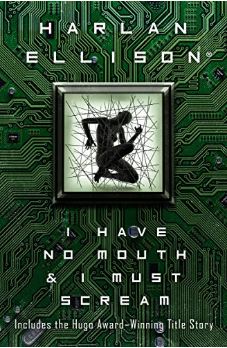
I picked it up with my prime membership for less than a song, free, in fact--which is precisely what it was worth to me. I have seen this book, or at least a book of Ellison's short stories with this name on the cover ever since I first started reading science fiction as a kid. The title alone struck me with all the sweetness of a shot of kerosene in a dirty glass with a needle in it. I always avoided it, even as a free library book. So why would I chose to read it now? I recently saw a documentary, or at least part of one, about Harlan Ellison. His life story was interesting, to severely understate the matter. In one clip he called Dan Simmons the best writer in the room. The show also indicated that those two writers had an extreme disagreement when they met, but the documentary didn't explain the nature of that disagreement. So the documentary prompted my curiosity, and I was also familiar with the Star Trek episode "City on the Edge of Forever" which Ellison wrote. Although that is a great episode, it's not my favorite. It is, however, much better than any of the stories in this book. Ellison is was (he passed away in 2018) obviously talented. He put words together in a way that piques my interest...and then consistently makes me sorry that I became interested. In these stories, he frequently launched a series of word punches with the apparent intent to pummel the reader into submission to  his innate superiority, to compel the reader into accepting the unbelievable story because he demanded it. It's a forced hallucinogenic trip by proxy, an overdose of LSD nihilism. I thought some of the stories had great potential and would have provided the settings for great novels. Instead, they all raced to the same rat hole of despair. I did enjoy a few of the stories until the endings. The endings were always predictable, saturnine, lugubrious, and grim. Of course, my opinion is vastly overshadowed by the hordes of Ellison fans. The guy can write. I'll have to try some of his other works to see if these stories merely represent one side of a great writer.

***

I'm suddenly reminded that I was thinking about actors that I would cast in roles for the characters in Threading the Rude Eye, and Power to Hurt. I think Dwayne "The Rock" Johnson would make a great Atu. I'm torn between a young Anna Friel and Zoe Boyle for the role of Cat. Jeremy Irons or Pierce Brosnan would be interesting choices to play Jonathan. Actually, I might like Irons for the role of Old Will. Antonio needs a young John Rhys-Davies type. A late 30ish Jeff Bridges might work for Charles, but I'm not sure about that one, as Charles keeps a lower profile than I've seen in a Bridges character. I wonder about the Alex and Lucette characters. I would play with the idea of a young Tom Cruise for Alex and a young Heather Lind for Lucette. I'm sure there are other good choices of actors who are the right age now, but they're not coming to mind. I may consider more roles, and reconsider these roles another time. It's not as if the series will be made into a movie in the near future.


Sunday, November 3, 2019

Just sit right back and you'll hear a tale--a couple perhaps. Let me begin with the movie and finish with the book. Both tales involved scoundrels, rogues, and the good guys who had to deal with them.

Here's the easy one; the lesser of the two tales, but an entertaining one nonetheless:


If you're looking for swashbuckling fun on the high seas, you need look no further than this little gem filled with pirate stereotypes and, arrrrhguably the greatest of them all, Blackbeard himself.

Robert Newton's portrayal of Edward Teach is more fun than a barrel of puppies with eye-patches and peg legs. If you don't think that's fun, you'll be swinging from the yarrrhdarrrhm before morning, matey. Of course Teach is a terrible scoundrel and murderer. He brooks no foolishness from his crew, but being his partner or ally may be more dangerous than being his enemy.


Newton provided one my favorite scenes in the movie when he tried to persuade his pirate first mate, Ben, that he wasn't trying to make away with the treasure for himself, but was getting it for both of them. Ben was played by the excellent actor William Bendix.

He's the guy in the middle, between the other pirate caricatures. Speaking of caricatures, one of the best from the film is this guy:


Gilly, played by Skelton Knaggs, oozes fawning evil and treachery. He reminded me of a leering orc, or grinning goblin.


And I'm guessing he stood tall at about 4'11" (but IMDB puts him at 5'5"). Wikipedia tells how he died at age 43. Can you guess what killed him?

If the cutlass fabricated from fun pirate stereotypes, swashbuckling action, murder and larceny (but especially larceny--watch the show and you'll get that joke) can't bend you to watch this movie, I have two loaded pistols with which to persuade you. The first of those is Linda Darnell. Has the camera ever loved anyone more?


She plays Edwina Mansfield, daughter of the pirate Edward Mansfield. She's planning to marry the equally piratical Henry Morgan who's played by someone I'll get to when I fire the other gun. She falls for Akuta Maynard who's out to reveal Morgan's evil ways and he wants to use Edwina's letters to do it. 


She has absconded with some treasure. Teach plies Edwina's lady-in-waiting (and you can guess the answer to what she's a lady-in-waiting for as given by the William Bendix character in the film) with rum and more rum to get her to spill her guts about the treasure. I forget her name in the film, but you know her.

Yes! It's:


Irene Ryan...but enough of that. I would much rather see Linda Darnell.


As you might suspect, Maynard and Mansfield end up together and Teach ends up like one of his treasure chests only significantly wetter.

Finally, the piece de resistance, the blast from the muzzle of the of second pistol: There's a hidden treasure in this movie--it's a Star Trek connection triple play.

First, there's Keith Andes as Maynard --better know to me from his role as Akuta in "The Apple"


And then there's Torin Hatcher as Henry Morgan--better know to me as Marplon from "The Return of the Archons"


And finally, the movie has Anthony Caruso as a pirate whose name I didn't catch--better known to me as Bela Okmyx from "A Pieceof the Action"


You can find out more about Caruso here--where I found the picture.

https://mikestakeonthemovies.com/2015/11/24/anthony-caruso-more-than-the-henchman/


As for the second tale, I find that I have more to say about it than I can reasonably include here and I don't want to give it short shrift as it is one of the best novels ever written--it's certainly one of my favorites. So I'll post it another time by itself.

***
As for my writing on Book 3 of the Tomahawks and Dragon Fire series, I've completed chapter one. I had to go back and adjust for time, considering that what's happening there is happening at the same time as what was happening in the final chapters of Power to Hurt--but this is across the pond--I had to consider the time difference as well as the time it took for the events in the chapter to unfold. Nevertheless, the chapter still ends with a literal blast.

If you've picked up Threading the Rude Eye and Power to Hurt, post those positive reviews on Amazon and goodreads. Only you can prevent the death of a great series. The more reviews, the more sales, the more excited I get to write, the faster I complete it--every body wins.

***
I read a couple short stories this week. I got each for free at different times. I won't mention the titles or authors because both were disappointing and probably don't reflect the true talent of the writers. I'll try to review something more substantial that they've written before I pass my own judgment on their works.

Saturday, October 26, 2019

Interview with Rachel Kovaciny


1. Please tell me a little about your current work in progress.

I’m writing a retelling of “Snow White and the Seven Dwarfs” set in the Old West.  Seven white orphans abandoned along the trail to Kansas are taken in by a wagon train of former slaves.  One orphan idolizes a beautiful immigrant who is a healer and seeks to learn how to help sick people from her, only to discover she intends to do away with her stepdaughter.  I call it One Bad Apple, and I’m planning to release it in early 2020.

2. Where did you get the idea for this book or series?

I got the idea for this particular book when I was teaching one of my kids American history a couple years ago.  One of the great things about homeschooling is that I often learn new things right alongside my kids.  I got a book about African Americans in the Old West out of the library for them and, while reading it with her, discovered there was this whole westward movement called the Exoduster Migration I had never heard of.

The Exodusters were freed blacks living in the post-Reconstruction South who got fed up with the oppression they faced and set off en masse for Kansas to start new lives. I thought that would make a fantastic setting for a western because I’ve always wanted to write a story about a wagon train, and there’s a lot of conflict inherent to that movement.  I ended up placing this book a little earlier in time than the actual Exoduster Migration, for various reasons, but that still works because many black pioneers did head out west before the Exodusters, just not in such great numbers.

I’d been wanting to retell Snow White, but couldn’t figure out how to work in the seven dwarfs since my retellings are non-magical.  But having them be white children surrounded by black people still gives them that sense of otherness, and that vulnerability that “seven little men, no bigger than your thumb” had in the version of Snow White I grew up reading.

3. Do you write in more than one genre?

Yes.  Besides my Once Upon a Western series, I’ve also written a lot of short stories set during WWII in the European Theater of Operations.  And I write a column about Wild West history for the Prairie Times as well as articles on various subjects for Femnista.

4. Tell me about something that you believe makes your writing unique or worthy of attention.

There aren’t many authors who retell fairy tales as westerns, much less build a whole series around that concept.  And most fairy tale retellings involve magic of some sort, but mine do not. 


5. Is there anything about your personal history or personality that manifests strongly in your writing?

I grew up watching classic cowboy movies with my dad, and until I was in double digits, I would tell people that when I grew up, I was going to be a rancher.  I have a deep love for learning about people living in times and places different from my own, and for seeing how their lives were similar to mine, and also how they were different.  I try to communicate that in my books.  Also, I’m a Christian, and my books have a distinctly Christian worldview, though I do my best not to let them become preachy.

6. What else would be helpful for readers to know about you?

I don’t know if this is helpful, but I think it’s pretty cool that I was born only a few miles from where Jesse James robbed his first train, and that one of my babysitters was an elderly woman who actually met Jesse James and his gang when she was a young girl herself.

Oh, it might be helpful to know that I have two blogs.  I write about movies and writing at Hamlette’s Soliloquy, and I write about books at The Edge of the Precipice. 

7. Excluding your own work, what author or book would you recommend that more people read? Why?

This is a hard question because a person’s taste in books is so subjective and personal.  I do think Jack Schaefer deserves more readers these days because he wrote such nuanced, intricate stories, like Shane, and gets overlooked in favor of more renowned authors like Zane Grey and Louis L’Amour.

8. Which of your books do you most highly recommend? Why?

Well, Dancing and Doughnuts is my newest release, and it’s such a fun story that I think most people would get a kick out of it.


9. Which break, event, decision, or fortuitous circumstance has helped you or your writing career the most?

Winning the Sleeping Beauty retelling contest from Rooglewood Press in 2016 and having my story “The Man on the Buckskin Horse” published in their anthology Five Magic Spindles really jumpstarted my writing career.  All my books and stories since them have built on that foundation.

10. What question do you wish you would get asked more often?

What’s your favorite John Wayne movie?  Almost no one ever asks me that.  It’s The Sons of Katie Elder, by the way.


11. Do you have a catch-phrase or quote that you like? What is it? And why do you choose it?

Write what you love.  People like to say you should “write what you know,” but with a little patience and digging, you can know a whole lot about any subject with a library card and the willingness to do some research.  But if you don’t love what you’re writing... what’s the point?


***

In my own writing, Book 3 (I'm still working on the actual title) of the Tomahawks and Dragon Fire series is starting to come together. After an intriguing prologue, I'm taking up the thread of Charles and Antonio and their special mission to France. An explosive end to chapter one is in the works. If you haven't read Threading the Rude Eye and Power to Hurt, the first two books in the series, get them now and post a review. These exceptional books need more reviews. Look for links to all my books in the left hand margin of the blog.
Yes. I mean you.
Thank you. Thank you very much.

Sunday, June 30, 2019


I came across a series of three lighthearted articles I wrote a few years ago when I was in a production of Dial M for Murder at the community theater. The first of those three articles follows after a message from our sponsor and some observations on two things brought to me by the magic of television.

First, I'm pleased to announce that Power to Hurt has passed the 70K word mark. Strive as I might, I may not have it ready for purchase before the end of July because I may need an additional ten-thousand words beyond my original projection to complete it--so I may have another 20K words to write. That also means longer to proof and to edit. However, the end of July remains my target date. **If anyone would like to read and provide feedback on the novel up to this point, let me know.***

Second, I have a few thoughts on two shows: Rogers and Hammerstein's South Pacific, and the more recent Good Omens. One of the very few things these two offerings have in common is that they were both new to me. I finished the last episode of Good Omens on the same day that I saw South Pacific broadcast on public television.

Weighing in at nearly two and one-half hours, released in 1958, South Pacific is a light musical romance. Good Omens, a sort of dark fantasy miniseries based on the book of the same name, is six episodes long; each episode lasts just under an hour. So these two aren't even in the same weight class. The genres are also worlds apart.

The other thing both of these shows have in common is that they both disappointed me a bit. I expected more from each of them. I heard a few songs from SP that I had heard before but didn't know the source. Part of the reason for that is that when it comes to musicals, I'm rather an uncultured cretin. My entire body of knowledge with regard to opera came from Looney Tunes/Merry Melodies. As a kid I soaked up fabulous episodes like "Rabbit of Seville" and "Kill da Wabbit" with the greatest of glee. These two are true masterpieces of animation and music. That was the pinnacle of my musical theater education. When I heard Mitzi Gaynor sing, "I'm Gonna Wash that Man Right out of My Hair" I immediately associated it with the hair color commercial that first taught me the tune. "Some Enchanted Evening" was very nice. I enjoyed that song more than any other from the show. I liked all of the music but there weren't many that stood out. I do remember thinking that I would like to remember a few of the lyrics, but I've forgotten them already. I do remember something about nothing being quite the same as dame, but I don't think that's an accurate rendition of the words. Also, there was "where she's narrow, she should be as narrow as an arrow...where she's broad she should be broad where a broad should be broad," and that may not be an accurate recollection either.


SP featured a young Frances Nuyen whom I first discovered in Star Trek reruns as Elana of Troyius in the episode of the same title and which I have mentioned on this blog before. So it does have a TOS connection going for it. My wife didn't seem impressed when I pointed that out.


What disappointed me about SP? I'm not really sure. Perhaps it was the fact that it went a little long and became entirely predictable by the second half.

As for GO, the music featured heavy doses of Queen, including in the last episode "Bohemian Rhapsody," if I remember correctly, and that was nice. The acting and production were fabulous. The story, a darkly humorous take on Christianity and Armageddon smelled of pablum to please the current pop culture masses. The great acting and memorable characters couldn't save a fundamentally weak story. The story aimed more toward clever wit than depth and struck the bull's eye.

***
The old article from 2015:
An Actor’s View – Dial M for Thunderball
The Weiser Little Theater's production of Frederick Knott's Dial "M" for Murder rolls ever forward like an unstoppable thunderball. I understand that the term "thunderball" originated with soldiers who used it to refer to the rolling mushroom cloud created by a nuclear detonation -- perhaps that's not the image that I wanted to convey.
Speaking of Bond movies, the intrigue in Dial M is top notch. While we weren't able to lure the 1965 incarnation of Martine Beswick, or Jill St. John from 1971's Diamonds Are Forever, we do have our own scorching hot actress who does all of her own stunts. She's as deadly as any Bond girl…don't mess with her while she's on the telephone. (Also, don't try to tell her that she's remembering a scene incorrectly; she will deliver a swift punch to your ego and do the happy dance on the remnants of your self-respect while blinding you with facts. Of course, that's just one perspective. Your mileage may vary).
In typical Bond fashion, Good and Evil are both sharply dressed in Dial M. More importantly, the men are dashing and debonair with classic good looks and diction that is to-die-for. But enough about me. There are other male roles in the play as well.
An unintentionally entertaining part of rehearsals is watching an actor steadfastly attempting to remember and repeat his lines. It's very much like watching a blind man tapping his way across a treacherous ledge in the dark (of course, it's always dark to the blind man, but that detail adds to the utterly false sense of suspense that I'm attempting to create). The lines come forth in tiny, tentative taps, back and forth, repeated until ideas trickle out in the proper wording and sequence. Sure it's as irritating as a root canal without anesthetic, but I've found that people can be so judgmental when you punch a blind man. I mean, it's endearing, really.
While we don't have a one-eyed Emilio Largo, we do have our own figuratively one-eyed man. He has an eye single to detail. Every. Single. Detail. There is no detail too small which, if neglected even for a moment, threatens to become a SPECTRE (see what I did there) that will destroy the entire play. Fortunately, it appears as if a nuclear holocaust will be avoided, thanks to the screw-gun which he wields with no mean skill.
No Bond film would be complete without small-time criminals and ne'er-do-wells. Dial M has an ideal facsimile of just such an incorrigible reprobate…and the character he plays is quite a miscreant as well. But seriously, observations about type-casting aside, the dude is perfect in the role. Nobody, I mean nobody, plays a better sheet-covered corpse. If you don't remember his death scene, which makes Out of Africa seem like a fast-paced action flick by comparison, you'll still be astounded at his dramatics immediately subsequent to the demise. A magnificent method acting success, some would say (I’m not sure who, but someone…maybe).
Although Dial M lacks the lurking sharks of Thunderball, we do have a superb stage crew; they lurk, light the set, and lend assistance to idiots actors who can't remember lines, find their props (or their own body parts without written instructions and a gps); they also keep everything running smoothly. They almost never bite (I would just say never, but…well, there was that one incident).
Finally, the ray of sunshine, our Domino and Moneypenny all rolled into one (and she's not nearly as lumpy as that sounds) is the director. There are no words to describe her (except those commonly used in mental health diagnoses -- but I'm not really qualified to repeat those). However, I think the expression delusionally optimistic would not be out of place.

Seriously, this is a blast!