Sunday, November 28, 2021


The Corsican Brothers were here at the Chateau du Chat Gris for Thanksgiving. The K-man got to help light (reluctantly) the final batch of coals I used to finish off the turkey. The bird turned out great, by the way, with a light smoke and orange flavor. It may have been as good as the turkey I smoked last year.

Following the gratitudinal repast, the four-wheeler refused all entreaties. It could not be persuaded, cajoled, or prodded into service. Instead, we enjoyed a rousing game that I made up on the spot. RC wanted to play a game with the Star Trek figures, and K-man manifested boundless enthusiasm for the idea as well. With five figures, a hunk of rigid insulation for a game board, homemade scenery and obstacles that consisted of a ruin, a big rock (played by an actual rock) a few trees and a wooded area, and the Guardian portal from The City on the Edge of Forever which came with some of the figures, along with several six-sided dice, some bottle caps and red wax, we sat down to the table to play. I should say that I sat down. The boys remained standing, moving about, and hopping with excitement. 

The visiting team included both Federation and Klingon crewmen. The home team consisted of two carnivorous dinosaurs, and a giant spider. It seems that the joint mission of frequent enemies had troubles with their small craft and had to land to effectuate repairs. While working to fix the problem, one crewman was bitten by a venomous creature. The venom didn't kill him, but sent him into a delirium and he leaped through the strange stone portal with a crucial part of the vessel. The rest of the team followed to find themselves in a strange new environment. Their mission required the crew to find the missing part, and to rescue the crewman who had gone unconscious, all while avoiding the unfriendly denizens who sought to make a meal of them. 

The game was complicated by the fact that RC insisted on adding more monsters/plot complications, and also a creature that wandered about according to his desires dispensing unsolicited healing. The Corsican Brothers had their men spread out for a more effective search. One Klingon bravely faced off with a dinosaur--and finished the game right there as a terrible lizard lunchable. 

One crewman took a wound in battle with a dinosaur; he escaped. Another red shirt made the dinner menu for a dinosaur, but the remaining crew escaped with the missing part and the passed-out crewman. A late arrival (one of RC's plot complications) tested his phaser on a dinosaur and found the results entirely satisfactory. I think the fact that most of the Star Trek figures were from the "Day of the Dove" episode, and carried swords rather than phasers or disruptors, is why the Corsican Brothers didn't think to try ranged weapons before they had already fed two comrades to the beasts. The giant spider did get in on the action, but neither took nor delivered any wounds.

In short, the Corsican Brothers and I had a great time with our little game. The chance to take a second or third action tempted the boys early in the game, but they began to see that the gamble usually brought unfavorable results. They stopped taking the gamble until the race to the portal at the end. After some close calls and frustrating die rolls, the K-man made it to safety with the crucial part, and RC carried off the unconscious crewman.

***

In other news, I'm working on the cover for The Shrinking Zone. Here are two possibilities for your consideration. I'm probably going to explore more font/color options for the title. 


Let me know if you think one is more appealing than the other for a novel categorized as a dystopian domestic thriller. It's a fanfare for the common man featuring action and adventure in a dystopian setting.

Here are some quotes I've included in the Author Foreword of the novel:

“May the Freedom and Independency of America endure until the Sun grows dim with age, and this Earth returns to Chaos.” –Toast given at a Massachusetts tavern in 1776 following the reading of the Declaration of Independence

“Show me that age and country where the rights and liberties of the people were placed on the sole chance of their rulers being good men, without a consequent loss of liberty?” –Patrick Henry

“They tell us, sir, that we are weak; unable to cope with so formidable an adversary. But when shall we be stronger? Will it be the next week, or the next year? Will it be when we are totally disarmed, and when a British guard shall be stationed in every house? Shall we gather strength by irresolution and inaction? Shall we acquire the means of effectual resistance by lying supinely on our backs and hugging the delusive phantom of hope, until our enemies shall have bound us hand and foot? Sir, we are not weak if we make a proper use of those means which the God of nature hath placed in our power.” –Patrick Henry

Get your copy of The Shrinking Zone in December.


Sunday, November 14, 2021


I was going to give the main character a flip phone in a holster. It would have been perfect for him. Except the dystopian society in which he lives in the high desert of the Western U.S. won't let him have one. He doesn't meet the necessary criteria and his son has possible ties to a suspected domestic terrorist group. Electricity is an intermittent luxury for him and his wife. The internet and cell service are only two of the things the government has forbidden to them. 

(here's a photo of a lizard completely unrelated to the novel I'm writing)

In this dystopian thriller, Don is a hardworking, blue-collar man just trying to survive. When his best friend's daughter is taken by the half-crazed subjects of clandestine government experiments, he calls on Don to help save her. How can Don rescue the girl when he must struggle against a power-mad demagogue in the desert, savage hybrid beasts, rebel forces, and the crushing power of a state rushing toward totalitarianism?

Find out in The Shrinking Zone -- coming soon.

I've had some great times writing this novel this week. The action has built to a crescendo and the chips are hitting the fan with exceeding rapidity. At its core, the novel is about families and friendships, but it's wrapped in thrilling action with precious lives and the fate of a nation at stake.


Saturday, November 6, 2021

 Links to my books are above.

Author Interview with

Cully Mack

Author of The Voice That Thunders Series

Please tell me a little about your current work in progress.

I’m over halfway through writing my Voice That Thunders Series and currently I’m writing book five. The series features siblings, Mirah and Gabe, who become central characters along with a band of rebels fighting against immortals conquering their realm. Think epic battles with Immortals and beasts of all kinds, throw in elemental magic, huge plot twists, portals and unique worlds, and an ever-growing number of characters trying to save their world. If you love character-driven fantasy, you'll love my books. I warn you now; I don't go easy on them.

Where did you get the idea for this book or series?

I have a fascination for mythology. The older the better. My primary sources are from myths from Mesopotamia. Most people have never heard of them. This is because, until around 150 years ago, the cuneiform tablets detailing their accounts was undecipherable. Mesopotamia is otherwise known as the birthplace of civilisation and its historical setting is in the ancient near east. Differing cultures lived in proximity, so there is a blending of myths and traditions. I mainly draw from the Sumerians, the Akkadians, the Semites and the Babylonians.

YA readers may have heard the term Nephilim from Cassandra Clare’s series or watching Supernatural among other popular sources. Most modern Nephilim depictions are drawn from Semite sources such as the Book of Enoch, where they are portrayed in an urban setting and regarded as fallen angel/human hybrids. As interesting as this is, the Semite account is only one version of the mythos.

Mesopotamian texts differ on many topics. For example, creation epics, deity names and culture heroes. But they agree on one thing… the gods came, slept with human women, and created giant hybrid offspring. Yes, those Titans, gods and beastly monsters from Greek, Roman and biblical myths were known to older civilizations! Some saw these gods in a positive light, others as negative. It makes for great conflict. I wanted to create a work more aligned with the earliest accounts of this mythos.

Do you write in more than one genre?

I write high/epic fantasy, myth, legend and fairy tale retellings, and speculative fiction. I also short film scripts and creative nonfiction.

Tell me about something that you believe makes your writing unique or worthy of attention.

I’m not afraid to write what the story needs. In places, it’s dark (but not grimdark). People die! The battles are intense, blending weapons, magic and intelligence. No one is safe! I’ve got messages from fans to prove it. I always tell them the same, trust me, keep reading. The monsters are unique. Ever heard of Dactyrs or Dagani? The cast is huge, with two or three plot arcs often running parallel, and narrated from multiple pov’s. I’m a discovery writer, so the edge of your seat plot twists in unexpected ways. You’ll find romance and broken hearts (sorry). Even so, romance isn’t the main plot. I’ve been told many times that my writing is very visual and how reading my books is like watching a movie. I’ll let you be the judge of that…


Is there anything about your personal history or personality that manifests strongly in your writing?

For many years, I worked with people who were the most broken, those experiencing homelessness, isolation, trauma, and addictions. My characters tend to go down similar paths, and even though their journey darkens, in one form or another, it becomes a redemptive arc, finding themselves, who they truly are, kind of thing. I’m an advocate for nothing and no one can break me unless I give them the power to do it. So, yes, I test my characters to the point of shattering, and watch them rise from their brokenness into who they were meant to be.

What else would be helpful for readers to know about you?

I’m on most social media

Links:

Amazon author link: https://www.amazon.com/Cully-Mack/e/B07QBLXZLT

Goodreads: https://www.goodreads.com/author/show/19033629.Cully_Mack

Twitter: https://twitter.com/CullyMack

Facebook: https://www.facebook.com/CullyMack

Instagram: https://www.instagram.com/cullymackauthor/

Excluding your own work, what underrated author or book would you recommend that more people read? Why?

Shawn Dressler’s A Tale of Cloak and Shadows. This was a new author for me. The prose is poetic, and the world is painted with vivid imagery. The way Galindel switches back and forth from the present to his memories is enchanting and intriguing. It’s not technically a novel, more of a prequel to the Kingdoms of Core series. Everything about it feels so alive and made for intense reading. The world building, characterization and dialogue were all spot on. An author to try out for sure.

Which of your books do you most highly recommend? Why?

I’d recommend book three, A Fire That Whispers. But to get there, you’d need to read the first two books in my series. Why book three? My writing is stronger. What I loved most about writing this book, is how the two main characters are trying to discover the truth but are unable to discuss and compare their findings. Nothing is as it seems. I drop hints and foreshadow the plot. There are some huge plot twists! Other characters who know the truth are possibly lying. Even I didn’t know how it was going to play out until the latter part of the book. The reader learns the truth as the characters do, because that’s how it was revealed to me. This is the beauty of discovery writing.


Which break, event, decision, or fortuitous circumstance has helped you or your writing career the most?

I had the opportunity to return to university to study English Literature and Creative Writing. As a mature student, I had a blast. I stayed on and completed my Master’s in Creative Writing.

What question do you wish you would get asked more often?

How can I join your mailing list? The best way to do this is to sign up for Sojin. A free prequel featuring Ammo and Sojin, two side characters in the Voice that Thunders series. It can be read at any point in the series.  https://BookHip.com/QVLCRL

Do you have a catch-phrase or quote that you like? What is it? And why do you choose it?

“It is the mark of an educated mind to be able to entertain a thought without accepting it.” Aristotle, Metaphysics


______________________________

Thanks to Cully for participating in the interview.

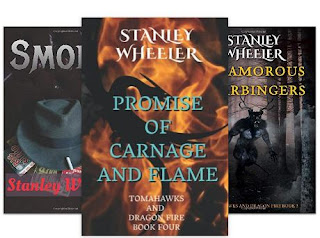
I had a great time writing this week. I did miss one day, but I made it up the next day. I'm on the home stretch in writing the dystopian thriller. It's an action adventure novel set in the near future--like the week after next--and it's a fun ride. Abductions, rescues, surveillance drones, government agents, farms attacked by gangs of drugged convicts, secret government experiments, oppressive government interference, conspiracies, plot twists, and unstoppable action are yours in The Shrinking Zone by Stanley Wheeler. Until that one is ready, I invite you to read my flintlock fantasy series in which the American Revolution, magic, and dragons collide. The series begins with THREADING THE RUDE EYE.


Sunday, October 24, 2021


I've finished reading Distopia by Robert Kroese.


This novel is book 2 in the Land of Dis series and seems to be a prequel to the first book. I haven't read the first book and I picked up this one for only 99 cents. It was money well spent.

Our protagonist Wyngalf is on a proselytizing mission for his little known faith. He soon finds himself voyaging to a distance shore from which no ships have returned. Along the way, he encounters the green dragon Verne, a runaway girl named Evena, and an erudite outcast goblin who is given to the study of philosophy. The goblin may be the most sane character in this story. 

The narrative, in my opinion, is Candide with dragons and goblins. The book has been compared to Prachett's work, but I enjoyed it more than I cared for The Color of Magic. Like Candide, Wyngalf (or Simply Wyngalf) is a naive character who faces frequent challenges to his religious and philosophical views. That is to say, they are challenged to the extent he has ever considered them. 

Wyngalf and Evena meet Verne upon a rock in the sea. I found the first encounter with Verne to be hilarious. Eventually Wyngalf's destiny, or at least what he thinks may be his destiny, pits him against Verne and a major city controlled by the dragon. Evena's home also becomes subject to Verne's wrath, or extortion racket. Of course, I'm holding a lot back because I don't want to spoil the book for you. The adventure takes exciting twists and turns with various characters passing across the stage as aiders and abettors, conspirators, and bit players. The entire matter comes to an exciting conclusion with plenty of destruction, and wrap up of the character destinies. 

The production is light on description and heavy on dialog that is both interesting and germane. A few scenes are well defined by colorful description, but usually the specific setting emerges in broad strokes so that the reader's imagination can supply most of the backdrop. That works well for a novel that is about dialog and ideas, and less about what color flowers and leaves might be, how many bricks are in each layer of the wall, or which mast, sail, or line on the ship is at risk. 

I did find the goblin's sheltered life and limited experience incompatible with his depth of knowledge regarding philosophy and the workings of the human shipping and governmental systems. I was also a little puzzled by some aspects of the dragon's initial introduction. However, it all contributed to the humor and the plot of the story, so I didn't let it bother me. Although Distopia is an adventure with action and conflict of all kinds, the discovery of ideas and issues of government and the right of self-determination, including how the road to tyranny can be paved with good intentions and notions of expediency, rise above the action.

Overall, I highly recommend Distopia. I give it four and a half out of five "best of all possible worlds."

__________________

If you want to hear about my ordeal on the slippery roof yesterday, or some of the unexpected events during the trip to Utah two weeks ago, you'll have to tap into my newsletter which you can find here: GET MY NEWSLETTER.

I see that something has happened to the links to my books on the left side of this page.  Click the image below to go to my website book page.

My dystopian thriller, The Shrinking Zone, has reached 58K words. I'm hoping to finish it by the end of the year. Inquiries about alpha and beta reading are welcome.


Thursday, October 21, 2021


Fun Fact: Let us cast a glance, or un coup d'oeil, at the French for this bit of history. In 1830, Charles X, King of France, issued the Four Ordinances of St. Cloud. Apparently the king felt that the elected government was too radical (and he had no desire to serve as a mere constitutional monarch, considering the kingship his birthright by divine right and all). These ordinances abolished freedom of the press, dissolved the newly elected Chamber of Deputies (the lower house of the French parliament which contained a majority elected in opposition to the king's policies), reduced the future number of deputies, curtailed the powers of the deputies, and disfranchised a huge portion of the electorate. You might think that such steps would be ill-advised in a nation that had already demonstrated a willingness ride the regicide railway to the bloody end. You would be right. 

If Charles X considered the citizens revolting before he issued the ordinances, he gained new insights with regard to that opinion almost immediately. The citizens were revolting, and they did. The disfranchised businessmen refused to lend money and closed their factories. The workers now had nothing better to do than to protest (what with the lack of bowling alleys and movie theaters at the time). The newspapers refused to be silenced. The police and military patrolled Paris to maintain order.

The fighting began on the evening of July 27. The fighting continued on the 28th to shouts of "down with the Bourbons," and "to the guillotine." (I don't think the latter phrase was meant as a toast). Charles at St. Cloud ordered Marechal Marmont (who had betrayed Napoleon in 1814) to quell the riot. Marmont, after taking in the situation and demonstrating himself to be the indecisive worm that he was, sent back a note to the king informing him that he no longer faced a riot, but a revolution. Marmont waited for immediate orders, lest delay result in a change of regime. Charles turned to his adviser Jules de Polignac. This minister, having been part Four Ordinances, told the king to double down and to resist rather than compromise. I don't see that the king ever provided Marmont with more specific orders.

By July 29th the populace had acquired weapons from the arms depots and gunpowder factories. They had erected barricades throughout Paris. The tricolor waved from many buildings. Marmont remained inert, failing to call in additional troops. He further handicapped his troops by ordering them not to fire unless fired upon. The populace took the Louvre, the Tuilleries Palace, and the Hotel de Ville. The politicians began the work of establishing a provisional government. Thus completed the second revolution against the Bourbon monarchy. Charles fled to England.

Unable to get out of a familiar rut, the French established a constitutional monarchy and placed Charles' 5th cousin Louis Phillipe, another Bourbon, on the throne. This monarchy would last until 1848 with the birth of the 2nd French Republic.

As long as I'm rolling here: The fall of King Louis Phillipe in 1848 does illustrate some germane points. By 1848, most of the populace could not vote and a third of Paris was on social welfare. Frederic Bastiat argued that political corruption, a complex system of permits, monopolies, and bureaucracy led to the revolt against Louis Phillipe. Political favors and protectionism allowed the privileged to dictate market conditions which resulted in the destruction or bankruptcy of many businesses. Bastiat reported that the French law makers were entirely unaware of the consequences of their radical policies. These factors caused the rise of the socialists and anarchists, and eventually another revolution. 

With political gatherings banned, those in opposition to the government held fundraising banquets. These were subsequently banned in February 1848. The Parisians reacted in the usual way with their anger directed at the king. With the torches and pitchforks converging on the palace, Louis Phillipe abdicated on February 24 and fled to England. By this point, there must be more Bourbons and their spawn in England than in France.

The new republic struggled as its incompatible aims were reduced taxes and greater social benefits. The republic established a work program building roads, planting trees and such, and taxed land to pay the workers. The small land owners and rural peasants could not or would not pay the tax. Turmoil, riots, and armed suppression of factions followed until the election of Louis-Napoleon Bonaparte in December.*

***

But enough revolution. I believe France is in its 5th republic which dates from 1958 and which may soon be its most long-lived republic. It's like they turn out republics like crepes.


Dead Horse Point, twenty-some miles out of Moab Utah. I was there for the third time last week. To clarify: I was only there once last week, but it was the third time that I had ever been there. It was part of a fabulous trip about southern Utah which prevented me from writing. I did however see some sights, visit the college kid, play cribbage with my root and branch, and drive a couple thousand miles. I am back home with my nose to the keyboard, having spewed words to the digital page like half-digested midway snacks on the tilt-a-whirl. I've probably used that simile before, but I still like it.

I have to be honest. As I hit the final third of the dystopian novel, I'm looking forward to slipping back into the Tomahawks and Dragon Fire series in the midst of exciting times in the American Revolutionary War. There I go, back to revolutions. They may not be fun to live through, but they can be fun to write about.


_________

*Most of the above was condensed from various wikipedia articles about the subjects.

Saturday, October 9, 2021


Author interview with

Anne Miles

Author of Sorrowfish


Please tell me a little about your current work in progress.

Hi, I am writing the first sequel to my debut fantasy book Sorrowfish. Sequels are in a way harder then first books I think. You’re basically writing a MIDDLE of the story, act 2 if you will –but as its own book. So to make it interesting and fun and wondrous and not bore your readers you must continue to inject surprises.

Where did you get the idea for this book or series?

I was brainstorming while in the midst of a horrible divorce in 1998 and this is what I came up with. It took me a long time to work up the courage to actually write the story.

Do you write in more than one genre?

No, I only write fantasy, though I could possibly turn part of this story out as a thriller and get away with it.

Tell me about something that you believe makes your writing unique or worthy of attention.

It’s chick-lit-wrapped epic fantasy with a splash of bourbon. Booknest said it was “for those who were looking for more than an axe to the face.”

Is there anything about your personal history or personality that manifests strongly in your writing?

I am a designer. I went to art school and I think it shows through in my writing. I’m extremely visual. 

What else would be helpful for readers to know about you?

I’ve been reading fantasy since I was very small. I started to read at age 2 and read Shakespeare at age 6 because he wrote about fairies. I love conspiracy theories of all flavors and used several of them in the planning of this series. (the 444 vs 432 hz one, specifically.) I despise posers. I had a shih tzu named Poco who inspired the character of Jax. He died toward the end of my editing process and I was heartbroken.

Excluding your own work, what underrated author or book would you recommend that more people read? Why?

D. Scott Johnson because his book Gemini Gambit is a cross between Ready Player One and The Girl with the Dragon Tattoo. He is amazing.

Which of your books do you most highly recommend? Why?

Sorrowfish (it’s my only book)


Which break, event, decision, or fortuitous circumstance has helped you or your writing career the most?

My editor Cheryl was my web site client. She was my client first, then I started writing. I would not have written or published without her. She was sent to me by God.

What question do you wish you would get asked more often?

What does Sorrowfish mean?
Sara isn’t selfish, she is sorrowfish. She acts from pain when she is hurtful to others, most of the time. That doesn’t mean it is okay to hurt others, but it does help her to understand and forgive herself and grow.

Do you have a catch-phrase or quote that you like? What is it? And why do you choose it?

“I drank what?” - Socrates

Because it is funny. It’s also a movie quote from Real Genius, which I think makes it golden. 

__________________

Thanks to Anne for participating.

In my own writing, I've passed the 50K word mark on the dystopian thriller -- which seems to be set in the time period encompassed by next week if things continue to accelerate like they have been. I talk a little more about that, and address the issue of whether Conan had ever read Leviticus in my newsletter, which you can sign up for here.


Sunday, September 26, 2021


Today I saw that someone else has also written a book which mixes fantasy and history with the founding of the United States. I'm guessing it would fit in the flintlock fantasy category. The author is John B. Hood John Hood and the book is called Mountain Folk. I believe it may be part of a series. He seems to have taken a radically different approach than I have, and I'll have to read it, but not until I've finished my own Tomahawks and Dragon Fire series. If you follow this blog, you know that I've complete the first four books in the series and have written some of book five. The plan is for book five to go through 1776, and book six will get through the Saratoga campaign -- of course, plans can always change.

Fun Fact:

I also discovered an interesting historical figure, Timothy Murphy. Mr. Murphy was an expert marksman with his flintlock rifle. He could hit a seven inch target at 250 yards. He is credited with the shooting of General Simon Fraser and Sir Francis Clerke at the Second Battle of Saratoga in October 1777.  Murphy was part of Daniel Morgan's Riflemen at the time. Benedict Arnold pointed out General Fraser to Morgan with some words about his importance to the British. Morgan called on Murphy to take out the troublesome British general. Murphy climbed a tree and made a 300 yard shot (after 2 misses) that unhorsed Fraser and which proved fatal to the general. Murphy's fourth shot killed Burgoyne's aide-de-camp, Sir Francis Clerke.

That's the "official" story. However, according to some sources it may contain more myth than truth. The Journal of the American Revolution article indicates that Murphy was there and may have been one of several riflemen assigned to target Fraser, but sources at the time do not name the rifleman. Well, someone shot Fraser, and as Max Scott the reporter said in The Man Who Shot Liberty Valance, "When the legend becomes fact, print the legend." So I may have to include Sureshot Tim Murphy in my series. Perhaps he can interact with my own character and expert marksman Lee. Maybe Lee will share a quote from the Iliad with Murphy.

On a related subject, who was General Simon Fraser? Like most of those British officers, he had a career before he came to America. He came to the New World during the French and Indian Wars. He was a captain with General Wolfe at the Battle of Quebec, He replied to a French sentry through the fog in the crossing of the St. Lawrence. The British got ashore and climbed to the plains outside Quebec where Montcalm came out to meet them and do battle upon the Plain of Abraham. It would be the final battle for both generals. If you've read my Tomahawks and Dragon Fire series so far, you may remember that in my story, that particular battle and the death of Wolfe are part of the villain's back story. But I digress. Back to General Fraser - Wikipedia says that this Simon Fraser is not the one pictured in the painting The Death of General Wolfe.

In 1776, back in America after more service in Europe, Fraser was promoted to the rank of Brigadier General. He commanded the vanguard in the taking of Fort Ticonderoga. In September during the Saratoga campaign, he led a successful attack against Morgan's rifleman at Freeman's Farm, but his troops took heavy casualties. On October 7, 1777, he was tasked with taking Bemis Heights as the key to the battlefield which would defeat the rebels. He fell to a rifleman's bullet at the age of 48. Fraser was buried that evening in a nearby hill.

My immediate project, the near future dystopian thriller, The Shrinking Zone, is at 47K words and moving forward.