Sunday, October 24, 2021


I've finished reading Distopia by Robert Kroese.


This novel is book 2 in the Land of Dis series and seems to be a prequel to the first book. I haven't read the first book and I picked up this one for only 99 cents. It was money well spent.

Our protagonist Wyngalf is on a proselytizing mission for his little known faith. He soon finds himself voyaging to a distance shore from which no ships have returned. Along the way, he encounters the green dragon Verne, a runaway girl named Evena, and an erudite outcast goblin who is given to the study of philosophy. The goblin may be the most sane character in this story. 

The narrative, in my opinion, is Candide with dragons and goblins. The book has been compared to Prachett's work, but I enjoyed it more than I cared for The Color of Magic. Like Candide, Wyngalf (or Simply Wyngalf) is a naive character who faces frequent challenges to his religious and philosophical views. That is to say, they are challenged to the extent he has ever considered them. 

Wyngalf and Evena meet Verne upon a rock in the sea. I found the first encounter with Verne to be hilarious. Eventually Wyngalf's destiny, or at least what he thinks may be his destiny, pits him against Verne and a major city controlled by the dragon. Evena's home also becomes subject to Verne's wrath, or extortion racket. Of course, I'm holding a lot back because I don't want to spoil the book for you. The adventure takes exciting twists and turns with various characters passing across the stage as aiders and abettors, conspirators, and bit players. The entire matter comes to an exciting conclusion with plenty of destruction, and wrap up of the character destinies. 

The production is light on description and heavy on dialog that is both interesting and germane. A few scenes are well defined by colorful description, but usually the specific setting emerges in broad strokes so that the reader's imagination can supply most of the backdrop. That works well for a novel that is about dialog and ideas, and less about what color flowers and leaves might be, how many bricks are in each layer of the wall, or which mast, sail, or line on the ship is at risk. 

I did find the goblin's sheltered life and limited experience incompatible with his depth of knowledge regarding philosophy and the workings of the human shipping and governmental systems. I was also a little puzzled by some aspects of the dragon's initial introduction. However, it all contributed to the humor and the plot of the story, so I didn't let it bother me. Although Distopia is an adventure with action and conflict of all kinds, the discovery of ideas and issues of government and the right of self-determination, including how the road to tyranny can be paved with good intentions and notions of expediency, rise above the action.

Overall, I highly recommend Distopia. I give it four and a half out of five "best of all possible worlds."

__________________

If you want to hear about my ordeal on the slippery roof yesterday, or some of the unexpected events during the trip to Utah two weeks ago, you'll have to tap into my newsletter which you can find here: GET MY NEWSLETTER.

I see that something has happened to the links to my books on the left side of this page.  Click the image below to go to my website book page.

My dystopian thriller, The Shrinking Zone, has reached 58K words. I'm hoping to finish it by the end of the year. Inquiries about alpha and beta reading are welcome.


Thursday, October 21, 2021


Fun Fact: Let us cast a glance, or un coup d'oeil, at the French for this bit of history. In 1830, Charles X, King of France, issued the Four Ordinances of St. Cloud. Apparently the king felt that the elected government was too radical (and he had no desire to serve as a mere constitutional monarch, considering the kingship his birthright by divine right and all). These ordinances abolished freedom of the press, dissolved the newly elected Chamber of Deputies (the lower house of the French parliament which contained a majority elected in opposition to the king's policies), reduced the future number of deputies, curtailed the powers of the deputies, and disfranchised a huge portion of the electorate. You might think that such steps would be ill-advised in a nation that had already demonstrated a willingness ride the regicide railway to the bloody end. You would be right. 

If Charles X considered the citizens revolting before he issued the ordinances, he gained new insights with regard to that opinion almost immediately. The citizens were revolting, and they did. The disfranchised businessmen refused to lend money and closed their factories. The workers now had nothing better to do than to protest (what with the lack of bowling alleys and movie theaters at the time). The newspapers refused to be silenced. The police and military patrolled Paris to maintain order.

The fighting began on the evening of July 27. The fighting continued on the 28th to shouts of "down with the Bourbons," and "to the guillotine." (I don't think the latter phrase was meant as a toast). Charles at St. Cloud ordered Marechal Marmont (who had betrayed Napoleon in 1814) to quell the riot. Marmont, after taking in the situation and demonstrating himself to be the indecisive worm that he was, sent back a note to the king informing him that he no longer faced a riot, but a revolution. Marmont waited for immediate orders, lest delay result in a change of regime. Charles turned to his adviser Jules de Polignac. This minister, having been part Four Ordinances, told the king to double down and to resist rather than compromise. I don't see that the king ever provided Marmont with more specific orders.

By July 29th the populace had acquired weapons from the arms depots and gunpowder factories. They had erected barricades throughout Paris. The tricolor waved from many buildings. Marmont remained inert, failing to call in additional troops. He further handicapped his troops by ordering them not to fire unless fired upon. The populace took the Louvre, the Tuilleries Palace, and the Hotel de Ville. The politicians began the work of establishing a provisional government. Thus completed the second revolution against the Bourbon monarchy. Charles fled to England.

Unable to get out of a familiar rut, the French established a constitutional monarchy and placed Charles' 5th cousin Louis Phillipe, another Bourbon, on the throne. This monarchy would last until 1848 with the birth of the 2nd French Republic.

As long as I'm rolling here: The fall of King Louis Phillipe in 1848 does illustrate some germane points. By 1848, most of the populace could not vote and a third of Paris was on social welfare. Frederic Bastiat argued that political corruption, a complex system of permits, monopolies, and bureaucracy led to the revolt against Louis Phillipe. Political favors and protectionism allowed the privileged to dictate market conditions which resulted in the destruction or bankruptcy of many businesses. Bastiat reported that the French law makers were entirely unaware of the consequences of their radical policies. These factors caused the rise of the socialists and anarchists, and eventually another revolution. 

With political gatherings banned, those in opposition to the government held fundraising banquets. These were subsequently banned in February 1848. The Parisians reacted in the usual way with their anger directed at the king. With the torches and pitchforks converging on the palace, Louis Phillipe abdicated on February 24 and fled to England. By this point, there must be more Bourbons and their spawn in England than in France.

The new republic struggled as its incompatible aims were reduced taxes and greater social benefits. The republic established a work program building roads, planting trees and such, and taxed land to pay the workers. The small land owners and rural peasants could not or would not pay the tax. Turmoil, riots, and armed suppression of factions followed until the election of Louis-Napoleon Bonaparte in December.*

***

But enough revolution. I believe France is in its 5th republic which dates from 1958 and which may soon be its most long-lived republic. It's like they turn out republics like crepes.


Dead Horse Point, twenty-some miles out of Moab Utah. I was there for the third time last week. To clarify: I was only there once last week, but it was the third time that I had ever been there. It was part of a fabulous trip about southern Utah which prevented me from writing. I did however see some sights, visit the college kid, play cribbage with my root and branch, and drive a couple thousand miles. I am back home with my nose to the keyboard, having spewed words to the digital page like half-digested midway snacks on the tilt-a-whirl. I've probably used that simile before, but I still like it.

I have to be honest. As I hit the final third of the dystopian novel, I'm looking forward to slipping back into the Tomahawks and Dragon Fire series in the midst of exciting times in the American Revolutionary War. There I go, back to revolutions. They may not be fun to live through, but they can be fun to write about.


_________

*Most of the above was condensed from various wikipedia articles about the subjects.

Saturday, October 9, 2021


Author interview with

Anne Miles

Author of Sorrowfish


Please tell me a little about your current work in progress.

Hi, I am writing the first sequel to my debut fantasy book Sorrowfish. Sequels are in a way harder then first books I think. You’re basically writing a MIDDLE of the story, act 2 if you will –but as its own book. So to make it interesting and fun and wondrous and not bore your readers you must continue to inject surprises.

Where did you get the idea for this book or series?

I was brainstorming while in the midst of a horrible divorce in 1998 and this is what I came up with. It took me a long time to work up the courage to actually write the story.

Do you write in more than one genre?

No, I only write fantasy, though I could possibly turn part of this story out as a thriller and get away with it.

Tell me about something that you believe makes your writing unique or worthy of attention.

It’s chick-lit-wrapped epic fantasy with a splash of bourbon. Booknest said it was “for those who were looking for more than an axe to the face.”

Is there anything about your personal history or personality that manifests strongly in your writing?

I am a designer. I went to art school and I think it shows through in my writing. I’m extremely visual. 

What else would be helpful for readers to know about you?

I’ve been reading fantasy since I was very small. I started to read at age 2 and read Shakespeare at age 6 because he wrote about fairies. I love conspiracy theories of all flavors and used several of them in the planning of this series. (the 444 vs 432 hz one, specifically.) I despise posers. I had a shih tzu named Poco who inspired the character of Jax. He died toward the end of my editing process and I was heartbroken.

Excluding your own work, what underrated author or book would you recommend that more people read? Why?

D. Scott Johnson because his book Gemini Gambit is a cross between Ready Player One and The Girl with the Dragon Tattoo. He is amazing.

Which of your books do you most highly recommend? Why?

Sorrowfish (it’s my only book)


Which break, event, decision, or fortuitous circumstance has helped you or your writing career the most?

My editor Cheryl was my web site client. She was my client first, then I started writing. I would not have written or published without her. She was sent to me by God.

What question do you wish you would get asked more often?

What does Sorrowfish mean?
Sara isn’t selfish, she is sorrowfish. She acts from pain when she is hurtful to others, most of the time. That doesn’t mean it is okay to hurt others, but it does help her to understand and forgive herself and grow.

Do you have a catch-phrase or quote that you like? What is it? And why do you choose it?

“I drank what?” - Socrates

Because it is funny. It’s also a movie quote from Real Genius, which I think makes it golden. 

__________________

Thanks to Anne for participating.

In my own writing, I've passed the 50K word mark on the dystopian thriller -- which seems to be set in the time period encompassed by next week if things continue to accelerate like they have been. I talk a little more about that, and address the issue of whether Conan had ever read Leviticus in my newsletter, which you can sign up for here.


Sunday, September 26, 2021


Today I saw that someone else has also written a book which mixes fantasy and history with the founding of the United States. I'm guessing it would fit in the flintlock fantasy category. The author is John B. Hood John Hood and the book is called Mountain Folk. I believe it may be part of a series. He seems to have taken a radically different approach than I have, and I'll have to read it, but not until I've finished my own Tomahawks and Dragon Fire series. If you follow this blog, you know that I've complete the first four books in the series and have written some of book five. The plan is for book five to go through 1776, and book six will get through the Saratoga campaign -- of course, plans can always change.

Fun Fact:

I also discovered an interesting historical figure, Timothy Murphy. Mr. Murphy was an expert marksman with his flintlock rifle. He could hit a seven inch target at 250 yards. He is credited with the shooting of General Simon Fraser and Sir Francis Clerke at the Second Battle of Saratoga in October 1777.  Murphy was part of Daniel Morgan's Riflemen at the time. Benedict Arnold pointed out General Fraser to Morgan with some words about his importance to the British. Morgan called on Murphy to take out the troublesome British general. Murphy climbed a tree and made a 300 yard shot (after 2 misses) that unhorsed Fraser and which proved fatal to the general. Murphy's fourth shot killed Burgoyne's aide-de-camp, Sir Francis Clerke.

That's the "official" story. However, according to some sources it may contain more myth than truth. The Journal of the American Revolution article indicates that Murphy was there and may have been one of several riflemen assigned to target Fraser, but sources at the time do not name the rifleman. Well, someone shot Fraser, and as Max Scott the reporter said in The Man Who Shot Liberty Valance, "When the legend becomes fact, print the legend." So I may have to include Sureshot Tim Murphy in my series. Perhaps he can interact with my own character and expert marksman Lee. Maybe Lee will share a quote from the Iliad with Murphy.

On a related subject, who was General Simon Fraser? Like most of those British officers, he had a career before he came to America. He came to the New World during the French and Indian Wars. He was a captain with General Wolfe at the Battle of Quebec, He replied to a French sentry through the fog in the crossing of the St. Lawrence. The British got ashore and climbed to the plains outside Quebec where Montcalm came out to meet them and do battle upon the Plain of Abraham. It would be the final battle for both generals. If you've read my Tomahawks and Dragon Fire series so far, you may remember that in my story, that particular battle and the death of Wolfe are part of the villain's back story. But I digress. Back to General Fraser - Wikipedia says that this Simon Fraser is not the one pictured in the painting The Death of General Wolfe.

In 1776, back in America after more service in Europe, Fraser was promoted to the rank of Brigadier General. He commanded the vanguard in the taking of Fort Ticonderoga. In September during the Saratoga campaign, he led a successful attack against Morgan's rifleman at Freeman's Farm, but his troops took heavy casualties. On October 7, 1777, he was tasked with taking Bemis Heights as the key to the battlefield which would defeat the rebels. He fell to a rifleman's bullet at the age of 48. Fraser was buried that evening in a nearby hill.

My immediate project, the near future dystopian thriller, The Shrinking Zone, is at 47K words and moving forward. 


Sunday, September 19, 2021


I want to talk about some fun characters, but first there's this review by youtube sensation Zach Johnson. A while back I provided him with copies of the first three books of the Tomahawks and Dragon Fire series. In this video, he only shows the first book, but he's talking about the first three.


Yes. Yes. We know this series is fantastic. I would like to discuss some of the characters from the series, and some characters from my other books as well.

Let me start with the first character of my first book. The protagonist from Justice in Season, a western set in  1860's Idaho Territory, was based on an actual person. In fact, many of the events in the book are fictionalized versions of some historical events. The historical figure wrote his own history in which we tend to see him in a positive light only, full of courage and determination. In crafting the fictional character, Victor McBride, I tried to preserve the courage and determination while furnishing him with a new background which also revealed fears and uncertainties. I think he may be all the braver for overcoming the fear and the trouble of his past. Most of the characters in Justice in Season and the sequel Justice Resurgent were fun to imagine and create. Some of them are based on historical persons while others are pure fiction. They were all fictionalized. A couple other favorite and prominent characters are Vaughn, the easy going poet and friend of McBride; and Harmony Rivers, the local singing sensation and object of the evil sheriff's infatuation.

In Threading the Rude Eye, (Book 1 of the Tomahawks and Dragon Fire series) we meet the protagonist Alex as a young man with a fiance and big plans. His plans are on hold until he can complete his indenture. He has a pronounced sense of justice and high hopes for his future. The revolution against empire unexpectedly slops over into his little world, completely altering his future and destroying all for which he had hoped. If not an opposite to McBride, Alex is certainly different. His fears and uncertainties threaten to control him. Unlike McBride who willingly rose to fight against evil, Alex has the fight thrust upon him. Alex's is not so much a story of vengeance as it is one of discovering the right course and committing to that course. His growth through the series isn't entirely linear. Initially, he has a lot to learn and a short time to learn it. At least he has a mentor in Jonathan to help him in the early stages of the adventure. 

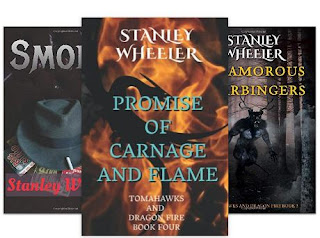
Iago and Atu are a couple of interesting characters, and are the first ones we meet in Threading the Rude Eye. Atu is a Pacific islander. His attire consists of a loincloth and a knife, with a total body cover of tattoos. He can be a bit loquacious and speaks like a British lord. Atu is teamed with Iago, the little man from Portugal. Iago doesn't speak. He communicates via a unique sign language which only Atu understands because the language is based upon Atu's tattoos. Iago makes the decisions and Atu provides the muscle. However, they are far from a simple brains and brawn match up. Atu is intelligent, but he defers to the small man for a few reasons--some of which aren't revealed until Book 4 Promise of Carnage and Flame. Iago's limitations and Atu's strengths make them a compatible and sympathetic pair. They are both tenacious and resourceful.

Akira is from Japan, but has become a successful businessman in England. In Threading the Rude Eye, we find him with one party of dragon hunters sent by King George III to procure a dragon. He may be the smallest in stature in the group of dragon hunters, but his size, good business sense, and store of Japanese proverbs are crucial to the survival of the dragon hunters.

We don't encounter Lee until Book 3, Clamorous Harbingers. He is a backwoods guide but his abilities go beyond that of a simple pathfinder. In his possibles bag he carries a bible and Pope's translation of the Iliad, and he can quote from both of them. One reader told me that she thinks he might be a wizard--which is certainly a cool idea which I will neither confirm nor deny.

There are some other characters, like Frode and Njal from Book 4, Promise of Carnage and Flame, that I wanted to talk about. I'll wait and talk about them, as well as the other dragon hunters at a later time.

One of my favorite characters is from my favorite book Smoke. The protagonist in that noir detective novel is Noah Vale, AKA Duncan Kane. A veteran of WWII, he may suffer from what in our day could be diagnosed as PTSD. Perhaps he gives his heart too easily, and he may not be completely honest with himself about that aspect of his character and his relationships, but he is dedicated and diligent--except to keeping his own house. In difficult situations he can always find guidance in one of the paperback novels he carries. 

Are you familiar with any of these characters? What do you like about them? What characters from other books have intrigued you? Let me know in the comments.

Sunday, September 12, 2021


For a ration of pure fun, I recommend this book


The Exploits of Brigadier Gerard by Sir Arthur Conan Doyle is a compilation of stories told by the fictional narrator, Etienne Gerard, of his adventures in Napoleon's Conflans Hussars. Gerard tells the stories in his old age, and humility has not dimmed the recollection of his fantastic exploits in the service of the Emperor. I suppose action adventure comedy would be the proper term to apply to the compilation. Much of the comedy arises from the narrator's bravado and false sense of modesty. 

The actions here are not the great deeds in the big battles of the era, but brave and gallant adventures, missions for the Emperor that occur on the fringes of the historic events. A few of the stories are remarkably similar to the adventures of Bernard Cornwell's Richard Sharpe character. By following a French hero, Doyle lets the reader romp about Europe instead of being confined to the peninsula. We see Gerard not only in Spain and England, but also in the east fighting Cossacks and outwitting his Prussian counterparts, carrying messages and state secrets through enemy troops, and charming women along the way. Although he is always brave and resourceful, he is not always entirely successful.

Gerard is hilariously unaware of his own vanity. These two quotes illustrate the conceit of the brave Gerard:

"It is true that I have had to depict myself sometimes as brave, sometimes as full of resource, always as interesting; but, then, it really was so, and I had to take the facts as I found them."

"I am an excellent soldier. I do not say this because I am prejudiced in my own favour, but because I really am so."

Those who fail to see the humor may find the narrator's conceit too much, but I think Doyle struck the perfect chord with this character. I find Gerard more entertaining that Sherlock Holmes. You will not see great depth of character or detailed descriptions in these stories. You will find exciting adventure and amazing exploits told with the skill of Sir Arthur Conan Doyle projected through the lens of the British military ideal as well as the stereotypical concept of French bravado, elan--and conceit.

Saturday, September 4, 2021


Author Interview with

Sean Valiente

Author of: Lightning Knight


1. Please tell me a little about your current work in progress.

My current WIP is the second book in my series! I’m about five chapters in and I’m already in love with it!


2. Where did you get the idea for this book or series?

It’s kind of a culmination of a lot of different ideas and experiences, but mostly I write from the perspective of the characters and they take me on their own adventures. It’s very exciting.


3. Do you write in more than one genre?

I stick to the fantasy genre because that’s what I love and that’s what I know. But that’s not to say there aren’t sub-genre’s that my books will have – fantasy with an aspect of political thriller, fantasy with a horror, etc.


4. Tell me about something that you believe makes your writing unique or worthy of attention.

It’s kind of a perfect blend of the classical fantasy that you know and love, but also some different takes and twists that you don’t see coming. It’s like hanging out with an old friend, but then going on a new adventure with them.


5. Is there anything about your personal history or personality that manifests strongly in your writing?

I have a pretty unique “voice” in my writing that definitely comes through on the page. My own personality is one of many different interests, and that is seen in my stories.


6. What else would be helpful for readers to know about you?

I’m all about the characters and their relationships. Plot is cool, world building is fun, but at the end of the day, my stories are character driven.


7. Excluding your own work, what underrated author or book would you recommend that more people read? Why?

Elana A. Mugdan’s YA Fantasy series The Shadow War Saga is excellent if you’re a fan of dragons and great stories!


8. Which of your books do you most highly recommend? Why?

The Lighting Knight – mostly because it’s the only book I have out!


9. Which break, event, decision, or fortuitous circumstance has helped you or your writing career the most?

I spent years playing around with ideas for my series and telling my friends all about them. One day my best friend Paige made me sit down and start writing for a 30 min sprint. Until that time, I had always had a hard time starting the process – but after that day, it’s like I couldn’t stop. And where we are now with a real book and it’s so cool!


10. What question do you wish you would get asked more often?

Can I buy you a slice of pizza? (To which the answer is yes)


11. Do you have a catch-phrase or quote that you like? What is it? And why do you choose it?

“Steave, no, Steave” – this is an inside joke between me, my wife, and my best friend Paige where we are imitating a very obscure movie line which we’ve modified. We find it very hilarious.

 Sean's Links:

___________________________________________

Best wishes for Sean's success with his writing.

In my neighborhood, I'm tickled to tell you that in just a few short days, all of my books will be available for the special price of only 99 cents each. This is the only time it happens. It begins, of course, on 9-9 and runs through 9-10.

Check out my books here Stanley's Author Page and use the remaining days to decide whether you want to explore my Adventure Fantasy series, my Western books, or my Noir Detective novel.