Sunday, July 26, 2020


The Fight for Princess Jedah Siroth of Melihum

The servant to the Prince of Dozanga gasped, his eyes wide in surprise at the dagger between his ribs. Princess Jedah Siroth of Melihum let her hand slip from the dagger's handle in the same moment that his hands reflexively clutched at the weapon. She placed both palms against her kidnapper's side and shoved him over the edge of the small flier. As his screams faded beneath the swift craft, Jedah knelt behind the windscreen and struggled with the flight controls. They wouldn't budge. The key to the locking mechanism had plummeted to the ground with the Dozangan. She remained a prisoner of the speeding vessel.

When dawn broke, so did the flier's buoyancy tanks. Jedah awakened to the detonation of the explosive bullets ripping open the tanks of the mysterious substance which allowed the craft to defy the planet's gravity. Another shot sent the propeller spinning away from the flier in a dozen jagged fragments. Her prison plunged, only the smallest cache of the buoyancy substance trapped in the remnants of the damaged tanks preventing a fatal free fall.

The green Zarhoon warriors knew their business, and seldom missed even at long range with their long rifles. The three scouts returned the rifles to the scabbards and drove the cantankerous beasts they rode toward the ruins of a small city where they predicted that the damaged flier would meet the ground.

Jedah clung to the falling wreckage. The moribund machine scraped the tops of the only stand of trees within sight. The branches hooked the ragged edges of one of the tanks, slowing the vessel's descent, but sending it spinning rapidly as it went to ground. The craft crashed, the thin metal crumpling in the collision upon the sparse, yellow, moss-like grass which disguised the unyielding surface. Jedah slammed into the control panel before bouncing from the craft and tumbling away from the flier like a rag doll in a gust of wind.

The princess awoke with no idea how long she had been unconscious. She rose to her hands and knees. Pain raced up her left arm and it buckled. She knew it was broken. She held the damaged limb against her body with the good arm. She ignored the blood streaming down the left side of her head and rose to her feet. Her legs wobbled, but held her upright. Through the throbbing pain that seemed to dim the sight in her left eye, she made out three riders approaching. Green men! She stumbled away toward the nearby ruins. As she entered the hollow remains of the destroyed and deserted city, she felt her awareness slipping toward shadow. She stagger among buildings until an arched doorway opened before her. Her balance failing, she pitched through the entrance to collapse behind a pile of debris.

"There, Nantos Nan!" Dav Ravos called out to the lieutenant, or Dapwar, of the formation--what was left of the formation, a mere four men, Nantos Nan, Dav Ravos, Han Hadron, and Mardos Tors.

"I saw a woman fly from the wreckage. She ran into the city, but her gait is unsteady. She is hurt," Mardos Tors observed. "Green men on their mounts. They chase her."

"I see them," Nantos Nan said. He ordered, "Into the ruins! We've got to find her before the Zarhoons take her. I recognized our princess. It is Princess Jedah Siroth of Melihum"

Two of the green men ran into the ruins. The third took the mounts to secure them. Vak Voka, the leader of the scouts, sprang forward and into the first doorway he saw. Meanwhile, Bak Badja. dashed to his right toward another doorway.

Han Tadron ran straight into the ruins and up a bridge near the center. Atop the bridge he saw Bak Badja searching an entryway. Mardos Tors fired his pistol at the four-armed man, scoring a hit against the green hide. Bak Badja dove through the doorway for cover.

Vak Voka quickly looked through the room, grabbing a small jar of unguent, before passing through an adjoining opening. When he lifted a suspiciously raised plank, a section of the floor gave way, dropping him twenty feet below to the ancient pits beneath the city.

Mardos Tors broke to the right to enter a building before which a patch of moss-like grass and scrub brush had grown. Nantos Nan broke to his left while Dav Ravos sped toward the doorway into which Bak Badja had disappeared.


Dav Ravos found the wounded Zarhoon sprawled just inside the doorway. Bak Badja raised one of his blades, but the man of Melihum batted it away and plunged his sword into the Zarhoon's chest. Bak Badja slipped into oblivion.


Bav Bavja, having secured the mounts, rushed into the ruins. He spotted Han Tadron upn the bridge and engaged the red man. Han Tanron could not stop the Zarhoon's whirling blades. One of the green man's swords laid open his thigh, but the red man refused to retreat, merely giving ground before his large opponent. Duty to his princess compelled him to remain in the fight.

Nantos Nan found the Princess! He lifted her unconscious form and placed her over one shoulder.

Dav Ravos heard the clang of swords upon the bridge and sprinted up the bridge behind Han Tadron's attacker. Before he could reach the enemy, the bridge ran red with the blood of his comrade, and Han Tadron's head rolled down the slope of the bridge.


Vak Voka powered his way up the side of the ancient pit to stand within the ruined walls once again. 

Mardos Tors saw the green warrior rise and aimed his pistol, across the scrub brush and through the section of collapsed wall, at the Zarhoon. Mardos Tors squeezed the trigger. A wound exploded on a lower shoulder and Vak Voka ducked for cover. Mardos Tors redirected his fire to Bav Bavja upon the bridge. The Zarhoon's chest erupted in a spray of flesh, fluid, and bone. Bav Bavja's body crumpled over the bridge rail to drop in a heap upon the stones below.


Dav Ravos leaped over the side of the bridge to confront the wounded Zarhoon leader, but the green man jumped to his feet, hardly hindered at all by his wound.


Dav Ravos lunged and drove back the Zarhoon. Vak Voka brought his two blades around, threatening the red man from above, below, and from both sides, driving Dav Ravos back to the doorway. Dav Ravos slipped in the Zarhoon's bodily fluid staining the floor. The green man spotted his opportunity and drove both blades into the red man, pressing him into the dirt. (Both shots, above and below, as seen from beneath the bridge).


Meanwhile, Nantos Nad has steadily progressed in carrying the princess from the ruins. He was almost safety when he tripped upon the wrap hanging from the princess' costume. The poor woman fell from his grasp as he hit the hard surface. 

Vak Voka sprang over the bleeding Dav Ravos, and loped to the fallen Nantos Nan. He pulled up next to the red man and the princess. He considered only for a moment whether to raise the limp form of the princess or to slay the disadvantaged red man first. Opting for the latter, Vak Voka swung a blade down in a deadly arc at the red man's head. Nantos Nan rolled and parried, sprining to his feet to surprise the green man. The two antagonists clashed beside the inert body of the princess. Vak Voka overpowered the red Dapwar, knocking him to the ground. 


As Vak Voka raised his blades for the killing stroke, Mardos Tors hurled himself at the green mountain of flesh, driving a sword through one set of ribs. The red man turned the Zarhoon, spinning him away from Nantos Nan and the princess, placing himself between the green man and his princess.

Vak Voka pressed forward to drive the red man back, but the smaller man refused to give way, and Vak Voka stumbled, falling in frustration. Mardos Tors could not pierce the net of steel woven by the Zarhoon's twin blades, and the green man regained his footing, wounding Mardos Tors as he did so. Nanton Nan, also on his feet again, plunged into the fray, only to be pushed away by the Zarhoon. 

Nantos Nan saw that Mardos Tors' doom was upon him, and turned to scoop the beautiful Princess Jedah into his arms. As he raised her, Vak Voka swords penetrated Mardos Tors' defenses, and the red man's torso as well. Nantos realized that this was his one chance to escape and preserve the princess, and exited to safety as Mardos Tors' body slid from the bloody blades of Vak Voka. 

Sunday, July 19, 2020


A Lunch in P-Town

I had come to town for a conference. It wasn’t just any town. It was P-town rising from the shadow of the mountains. It was the bustling university town below the humongous white letter plastered upon the slope, shouting its endless interrogatory. It was DJ’s P-town. Sure, plenty of authors and wanna-be writers inhabited the P-town hood, but I knew only one of them personally. Provided “personally” includes strictly via the internet.

Powers beyond my control—which doesn’t narrow it down much, I know—decided to move the conference to another day. They did not consult me. I understood that my personal gravitas fell somewhat short of swaying those mysterious powers to reschedule the matter at a time more suitable for my schedule. While I missed the conference, I did get to rend the virtual veil and meet the esteemed Duke of American Speculative Fiction in person. It happened like this—mostly:

I contacted the author on Friday to confirm the lunch appointment. He didn’t even attempt to feign ignorance of the rendezvous which had been set a week earlier. I chalked that up to the fact that he had not previously met me, and had not read anything I’ve written. I allowed him to enjoy his blissful ignorance. He informed me that he would be the 6’7” guy with a mustache. I let him know that I would be the opposite of that, at least as far as the height and facial hair were concerned.

The following day I sent him a picture so he would know what I looked like and what I was wearing. When I looked at my picture, the shirt looked gray to me. I wore a pale maroon or burgundy shirt (that might be mauve for those of you who can recognize such things), so I sent another clarification text as to the color of the shirt, as if my mug beneath the pate, which the follicles were abandoning like rats from a sinking ship, was insufficient to identify me. A certain nervous tension had crept into the corners of my consciousness. I had never met an author with his own Wikipedia entry before.

Google told me that I was only three minutes from the location for the lunch meeting. I decided to leave ten minutes ahead of the scheduled hour, just to be safe. Once I got to the car, I remembered that I had forgotten something—my wallet or phone or something, I think. By the time I found whatever it was I had forgotten, and got on the road, I only had three minutes. The Google directions refused to work, but I did have the map. I nearly drove right past the place. I turned the car rapidly into the cross street but couldn’t find a spot on the side. I had to drive over the curb to get a spot back in front of the establishment.

I recognized him immediately as I got out of the car. He stood five inches taller than John Carter, and he was the only guy standing in front of the door. The picture he had sent earlier also helped. I must admit that while the numbers would indicate that he is only a foot or so taller than I am, it felt like he was about three feet taller. He welcomed me inside like a gracious host, and never made a move for either the radium pistol or the longsword. In fact, he bought lunch for me.

While we enjoyed our meal, he answered my questions. The narrow mustache, which was full but not bushy, and turned down past the corners of his mouth, along with the lively eyebrows communicated a look of both intensity and devil-may-care—sort of like Snidely Whiplash after a shot of morphine. He didn’t merely answer my questions, he provided explanations and reasoning beyond the answers. I should have asked more follow-up questions, but the information came rapidly enough that my short attention span moved from one topic to the next.

I could have spent several hours, instead of only two, talking with DJ. Like a good conversationalist, he asked about my family, and writing, and background. He has an ability to cultivate people, to draw them into engaging conversation so that they feel important as well. I stumbled over my words and forgot how to describe topics upon which I had given complete and detailed presentations—it’s a gift, really, that I would return if I could; I think it makes me approachable and endearing, notwithstanding contrary opinions.

We did discover an insane amount of parallels in our lives. I’m convinced he’s a taller, better looking, more successful version of myself. He expounded on his ability to be stupid, proud, and vain – but those weren’t the only things we had in common, and those may be the only areas in which my abilities exceed his. I hope we have the chance to get together again.


***

A quick game of my skirmish game. I've changed the dice used for the game to make the numbers smaller. It seems to work quite well, accomplishing my aim without messing up my great system. In this scenario, which I've played multiple times under the previous rules, some musketeers are attempting to rescue a condemned man from the hangman's noose. Five of the Cardinal's Guard are on hand to thwart the rescue.

Above, the musketeers have entered the fray. Several bystanders are also in the square to witness the hanging. Andre, in the lower left didn't get very far before failing his activation. D'Hubert on the lower right has rushed in to distract two guards. Armand has knocked down the leader of the guards, knocked out the hangman, and snatched the prison at the upper center, but the guards are about to set upon him. Paul, just left of the gallows, has engaged two guards.


 D'Hubert slew one guard before introducing his own vital organs to the sword of the other. Armand also went down beneath the combined steel of two guards, leaving the prisoner standing alone. Paul, in the foreground left, has been twice wounded and retreated from the two guards with which he was engaged. Andre rushed into the fray, killing one of Paul's antagonists, and is racing to save the prisoner. The green bottle caps mark special things which may help or hinder the musketeers in their mission.


Here we have Andre, the last musketeer, holding three guards at bay. You can also see the red martian model acting as the hangman who has regained his feet. Andre did get to the prisoner and escaped with him before the guards could stop him. The guards couldn't get coordinated against the bold musketeer. Andre got off to a poor start, but completed the mission even after the rest of his team had perished.

Sunday, July 12, 2020


A Clash of Titans

Flashes of silver in the afternoon sun—the duct tape, which held together one of the black, high-top shoes he wore—attracted the eye to the slow, stiff gait that carried him over the path along the reservoir. The pale sand and fine gravel on the road-like path crackled beneath each step. He walked a short way around the trail carrying the metal tackle box which had weathered to the color of bleached-salmon meat. The other hand grasped a bundle of fishing poles. He selected a wide spot upon the bank between two stands of trees. The location whispered a promise of a catch of something beyond the abundant moss which scarred the surface here and there like weathered green scabs.

He stepped down to the water’s edge, his keen eye scanning the deep green water. It had been the work of but a few minutes to grab one of the fishing poles and to attach a lure from within the tackle box. He sensed that his efforts would be rewarded. While sons and grandchildren roamed far down the bank to test their luck at various locations, he planted himself in this spot like an oak—he would prosper or fail there.

Little fish followed the lure through the translucent green water as the sun’s rays reflected upon tiny wave-tips as from a thousand fragments of broken mirror. The fish followed, but refused to take the lure. He landed some moss. Eventually he switched poles and lures. He did this two more times. The man. The poles. The sun. The water. The moss. The little fish no longer pursued the lure. The moss tentacles about the lure mocked his efforts. Finally, he took up the last pole. He was testing the instruments to choose which to take on the pack trip planned for the following day. He also selected a new lure. He had never used this lure before. With its fish-like appearance; red tint; flat, elongated nose; and bright hooks, the strange lure flashed in the sun like an ancient talisman.

Meanwhile, the younger fishermen had discovered a grain of truth in the words of Sir Walter Scott who wrote in Waverly, “[O]f all diversions which ingenuity ever devised for the relief of idleness, fishing is the worst qualified to amuse a man who is at once indolent and impatient.” They terminated their bootless efforts and hooked their lines to their poles. The woman with them called the children to leave their swimming and to climb the bank so that they could return home.

When the younger men, the woman, and the children reached the fisherman, he stood upon the bank, the fishing pole bent like Hercules’ bow before the arrow’s release, one hand peculiarly twisted in a hold upon the reel.

“Is it a fish or snag?” one of the sons asked.

“I had a fish. He took it and spit it out into a snag.”

“Are you sure?” the younger man asked again as the end of the angler’s pole began to quiver like a frigid four-year old.

“I’m not sure. This pole doesn’t have a crank, I couldn’t reel it in.”

The younger men examined the pole. A broken shaft extended an inch from the body of the reel. The older man’s fingers clamped the shaft in a desperate grip.

“I cast in and the fish hit right away. I didn’t notice the reel was broken until after I cast. I can’t reel it in.”

One son, like Hephaestus forging a sword, rummaged among the other poles and removed acrank from one of the reels. While the angler held the pole and the line, keeping it taut with the pole bowed in submission, the son removed the broken shaft and screwed the new crank into place.


No longer a mere man desperately clinging to a broken rod, the angler transformed into a hero of Greek myth with weapon in hand, prepared for battle. The brief tremble which had earlier passed through the pole had convinced him that a fish still held the lure. The hero moved along the bank, drawing back upon the pole in an attempt to drag the underwater foe from the stronghold into which it had fled. This way and that upon the bank the hero moved, testing the line, challenging the foe. The line, stretched to its limit, glistened in the rays of the lowering sun like the shaft of a silver spear. No angle, no position, no amount of force which did not threaten break the line changed the status. The hero. The pole. The line. The unseen foe.

“It may be a snag,” he said.

“It looks like a snag,” one son said.

“I think it’s a snag,” agreed the other.

Admitting that the fisherman’s opponent could be nothing more than a snag slathered dirty slush upon the sultry dream of what might be. Hope became tarnished with dismay. The heroic glaze which had graced the angler only moments ago began to dim. The story which pressed to be recited and retold around dinner tables and campfires about the first cast with the broken pole and the mysterious lure to catch a fine fish commenced to fade. The promise of a fish story, like the sun at the end of the reservoir, began to dip below the horizon. The hero must diminish once more into the man with the stiff gait and duct-taped high tops. Perseus had fallen and could not get up. Gandalf had been stymied at the Doors of Durin. There would be no joy in Mudville.

The dream-quenchers who gathered like sharks about the angler, repeating the new mantra of the snag, had not reckoned upon the mermaid, that gift of the gods to help mortal men in their time of distress.

Resigned to defeat, or at least appearing to succumb to the repeated mantra, the angler said, “Who wants to swim out and get my lure?”

“I’ll do it,” the woman said.

She began to shed rings, accessories and shoes like a bare knuckles boxer preparing to enter the ring. She stepped into the flood. The dark green water swallowed her pale legs, and enveloped her black shorts. The wave rose to cover her black top, leaving exposed only her shoulders and the dark hair gathered atop her head in a black tower. The moss in the water brushed her legs, raising thoughts of underwater monsters, snakes, or worse. She gritted her teeth and thrust those thoughts away.

“Pull it straight up,” the angler directed as she reached for the silver thread which bound the angler to his dream--to his destiny.

She found the line and followed it beneath the surface, submerging herself in the dark green underworld. With the line in hand, she pulled it out, away from the bank. The line went slack.

What had prompted Poseidon to loose the Kraken from its lair, we will never know.

She didn’t notice what happened to the line next. Images of sea beasts and unspeakable denizens of the depths flashed through her mind when the thrashing tail of the Kraken whipped between her knees.

“Ah! It’s not a snag!” she screamed as her head broke through the dark surface. “It’s a fish! I felt its tail between my legs. I think I peed a little!”

Adrenaline continued to rush through her body as she chose flight, swimming away to escape the battle between hero and titan.

The angler reeled and pulled. The tenuous silver thread binding him to destiny moved back and forth upon the water, but always it moved closer to shore. Fighting and thrashing, the Kraken struggled against the hero’s might but it could not resist the conspiracy of the gods to crown the hero with victory. With a final lift of pole and line, the angler brought his catch to the bank.

Another messenger of the gods appeared. Stripped to the waist, his long blond hair bouncing in time with his hasty steps, the newcomer proclaimed the Kraken a defeated titan.

“I heard the commotion. When I heard her say she peed a little, I had to come see the excitement for myself,” the messenger laughed.

Not with Medusa’s head, but with the brave-yet-frightened mermaid, the hero vanquished the Kraken. The messenger of the gods produced a scale with which to weight the trophy—it was a big, big fish. The mantra makers silenced. The weird lure. The broken reel. The Kraken pulled from its cave. Accolades to the hero.

The hero had no need to boast, but carrying the spoils of battle on the way back to the pickup he stopped to ask every angler along the bank how they were doing—while the huge bass dangled from his hand above the duct tape upon his shoe like slain Hector behind Achilles’ chariot. The myrmidons carried the poles and the worn tackle box in his wake.


Sunday, July 5, 2020


A Declaration in the Shadow of Defeat


“The cause of America is in great measure the cause of all mankind,” wrote Thomas Paine. “The sun never shined on a cause of greater worth.” In the last days of 1775, the jubilation stirred by American heroics at Lexington and Concord, and Bunker Hill faded into harsh winter. The American invasion against the British in Canada met with failure beneath the walls of Quebec City when General Richard Montgomery, who had successfully taken Fort St. Johns and Montreal, was killed; Benedict Arnold wounded; and Daniel Morgan taken prisoner by the redcoats. British armies stood poised to invade New York through the Champlain valley, and from the sea. The president of the Continental Congress reported, “Our Affairs are hastening to a Crisis and the approaching campaign will in all probability determine forever the fate of America.” Such was the impending crisis which led to the Declaration of Independence.

In the wake of the disaster at Quebec, Thomas Paine published Common Sense. Paine renounced reconciliation with Great Britain and its tyrant king. He expounded upon the case for independence, the “bounteous change that would be to the benefit of generations yet unborn.” Paine’s pamphlet became the talk of the colonies, and the Continental Congress heard that talk. Word that King George sought German mercenaries with which to impose his will on America, and the terms of the American Prohibitory Act—another retaliatory measure designed to cutoff trade, shut down business, and endanger American shipping—augmented the voices for independence. Congress quickly came to an agreement with a French firm to provide oil, tobacco, and other provisions in exchange for arms and ammunition. The loss of significant portions of two armies enlarged the need for French supplies, French shipping, and French aid—none of which could be expected if a reconciliation with Britain remained a possibility. Congress had to declare independence in order to remain in the war.

In June Richard Henry Lee introduced in Congress a resolution declaring in favor of independence. While many of the colonies clamored for independence, others had not yet embraced that extremity. Congress recessed, appointing a committee to draft a declaration of independence. Jefferson completed the primary draft of the document—the statement of the American Cause. Although many expressions within the declaration can be traced to James Harrington’s Oceana, and John Locke’s Second Treatise on Government, the sentiment sprang from the recognition that government exists to serve the needs of the people, rather than that the people exists to serve the whims of the government.

When Congress reconvened to discuss the declaration, John Dickinson rose and spoke for two hours in favor of reconciliation. He warned against bringing France into the war, and favored the protection of Great Britain for prosperity and security. John Adams began a lengthy response, during which a storm of thunder and lightning rolled through Philadelphia. Accompanied by crashes of thunder, Adams declared for independence. He emphasized the necessity of foreign assistance for victory—and which would not be forthcoming without a separation from England. Nearly every member of Congress spoke upon the subject. While the delegates spoke, Howe’s ships approached the coast of New York. The New York legislature packed up at Howe’s approach, leaving its congressional delegates without direction on how to vote on the matter of independence. The remaining twelve colonies voted unanimously for independence. Nevertheless, a number of the individual delegates voted against independence. Dickinson resigned after the vote.
Congress soon approved the Declaration of Independence after making numerous changes to Jefferson’s draft. John Adams wrote to his wife that the acceptance of the Declaration of Independence “will be celebrated by succeeding generations as the great Anniversary Festival. It ought to be commemorated, as the day of deliverance, by solemn acts of devotion to God Almighty. It ought to be solemnized with pomp, shows, games, sports, guns, bells, bonfires, and illuminations, from one end of the continent to the other, from this time forward forever.” Of course Adams knew that the nation would pay a steep cost in blood and toil to maintain the Declaration; he saw beyond the immediate difficulties. “[T]hrough all the gloom, I can see the rays of light and glory; I can see that the end is more than worth all the means, and that posterity will triumph…” Perhaps once source of Adams’ optimism springs from the inspiring words of the document itself and the aspirations of the American Cause they proclaim:
 We hold these truths to be self-evident, that all men are created equal, that they are endowed by their Creator with certain unalienable Rights, that among these are Life, Liberty and the pursuit of Happiness.--That to secure these rights, Governments are instituted among Men, deriving their just powers from the consent of the governed…
Abraham Lincoln referred to the Declaration of Independence as words “fitly spoken,” an “apple of gold” which the Constitution was designed to protect. The ideals of the Declaration--the American Cause--were truly revolutionary in an age of kings and princes. Those principles remain the foundation of our liberty, the principles for which our forefathers pledged their blood, treasure and sacred honor.


Sunday, June 28, 2020


After finishing the paperback formatting, I needed a treat. I invited myself to watch a Combat! episode during the week. Here's the recap.


Combat!

Season 1 Episode 14:”The Medal”
Written by Richard Maibaum. Directed by Paul Stanley.
The episode opens with a view through binoculars (see picture above). Cut to the squad and Hanley behind a stone wall. They’re cutting through to reach the highway near Corbeil (or somewhere that sounds like it). The Germans are at some town, Malon, three miles further east. Cut to the episode’s NPCs  guest players, not mere NPCs—they joined for an evening of gaming after having heard about all the fun Saunders and the gang have been having. It looks like Frank Gorshin--.


(with much less makeup that he had in that Star Trek episode which ranks among the least rewatchable on my list)—and Joseph Campanella.

Freddy (Gorshin) has a blister. Vince (Campanella) is a married man with a child. Saunders interrupts the chatting men to tell them to get up and move out. The squad goes over the broken wall, moving forward to ominous music. There’s a tank under camouflage! And German soldiers! It looks like an ambush!

Roll the opening credits. Cue the bayonets and helmets. (I must admit that Combat! has one of the best and most memorable opening credits ever – I’ve probably mentioned it before, but it’s been a while since I treated myself to one of these episodes).


The tank opens fire, but the soldiers remain hidden. The squad makes a saving throw against shrapnel damage – getting double nines (I use 2d10s in this game) for the successful save as they all scramble for cover. When the tank cruelly murders a tree without any provocation, Hanley orders the squad back to the wall. The MG atop the tank delivers a series of dots and gashes to a fleeing American. The rest make it back to the wall (which now looks like a prop covered with a painted cloth where Saunders rolls over it). Except Vince and Freddy are in a shell hole—they didn’t get back to the wall. Saunders is asking Hanley what they’re going to do now. (The DM tells them to go into the kitchen and find some snacks while he plays out the next bit with Vince and Freddy).


Vince tells Freddy they can take out the tank. Freddy rolls successfully to disbelieve—and tries to get Vince to shrug-off the crazy—but Vince is new to the game and wants to get into the action—as in action hero time. He crawls along a ditch with a small stream of water in it. Freddy discards his initial good sense to instead embrace a fear of missing out on the massive XPs offered by the prospect of taking out an enemy tank.

Vince crawls from beneath a bridge and gets the exposed gunner on the tank in his sights. Bang! Vince expedites a missive of HP depletion—taking out the gunner. He follows by running to the tank and dropping a little pineapple of destruction inside—a tasty treat that fills the vehicle with fun-sized shrapnel, and fills the occupants with perforations as they fail their saving throws. Now the German soldiers rush from cover, just in time for Vince to test his captured MG skill rating.


Vince discovers a secret talent for mowing down Germans who rush toward him in the open. (It’s at this point I’m thinking that Vince isn’t going to make it to the closing credits, and Freddy is going to get the accolades for Vince’s foolish bravery).


Yep. I was right. A German with a Luger flanks Vince and drops him with a single shot. The Germans gather round as Luger-man is about to give Vince the coup de lead poisoning. The Americans attack before Luger-man delivers the second shot. The Germans abandon the tank and rush to who-knows-where. (So maybe Vince didn’t lose all his hit points). Cut to Freddy crawling from beneath the little bridge across the ditch. Vince moves! Freddy runs to him. Freddy mounts the tank in a rage, and opens up with the machine gun, spraying an apparently empty battlefield until he’s out of bullets or the gun jambs, and he collapses over the piece. (The rest of the gang has brought the snacks from the kitchen and they rejoin the game). The the squad runs up. There aren’t any live Germans in the field, only the many corpses created by Vince’s turn at the MG.


Cage pulls Freddy off the gun and down from the tank. Everyone believes Freddy killed all those Germans. They move to a farmhouse. Vince remains unconscious.

Hanley tells Saunders the unit needs a moral boost. He reads a notice he has been given about awards and decorations being awarded promptly and on an equitable basis. Saunders responds, “So?”
Hanley is putting Freddy in for a silver star. Saunders doesn’t believe it’s fair to pick one man out above the rest. Hanley thinks the tank and 17 dead Germans warrant recognition for Freddy—and has Freddy join him and Saunders. When Freddy gets the drift, he protests that he didn’t do anything to deserve a silver star, but is interrupted by news that Vince is conscious. Vince calls for Freddy, and the DM has Vince roll for recovery or death: a 3 and a 4. It’s not looking good for Vince. The DM allows him to roll for a last chance at survival using the heroic point he acquired in his earlier action: a 2 and a 3. Perhaps he can deliver some important last words: a 1 and a 2. No survival. No final words.

Vince, now dead and out of the game, complains that this game stinks. How can he just die like that? This game isn’t fun! He’s never going to play again. He storms out. He’s also the ride home for Freddy and one of the other guys. The DM calls it a night. They’ll pick up next week from that point.

When the game restarts, its chow time the next day. Freddy and the rest of the squad are there. The DM gives Saunders some letters. There’s one for Vince, which Saunder’s pockets, and another he gives to Freddy. Freddy goes off alone to read the letter. He wads it up, and takes a photo out of his pocket. Freddy tears the picture in half and throws it to the ground. Cage, on picket duty, observes Freddy. Cage picks up the two halves of the photo. He figures it was a Dear John letter and attempts to ease Freddy’s feelings—Freddy rolls a 7, and remains uncomforted.

Freddy goes to see Hanley and Saunders. He’s ready to tell them about what happened. He tells the story, taking credit for Vince’s heroics—no point in letting all those XPs go to waste. While Hanley’s out on a radio call, Saunders and Freddy have a brief discussion. When Hanley returns, they have to move out.

Cut to the squad moving through a shelled town, and blasting open a hole in a barbed wire obstacle in the street. A German in the wine shop begins firing as Hanley goes forward. Freddy goes to Hanley’s side—he can’t have his ticket writer to a silver star getting his ticket punched.


The German gets away. Hanley reminds Freddy not to be foolish, “What good is a medal if a guy’s not around to collect it?”—which might have been what Freddy had already considered with regard to Vince.

Cut to night in another destroyed French town--Malon. Hanley’s on the radio saying that the Germans have pulled out. When Freddy comes in, it is apparent that he has missed the fighting. He claims he came up the wrong trench and by the time he got to the right place, everyone had gone, so he went with some guys from another platoon. Caje, whose main task this session seems to be to intrude with news, says that a prisoner who speaks English has been taken. I’m thinking, odds are good that the prisoner is going to be Luger-man who shot Vince. It is.


The prisoner says, “It’s no disgrace to be taken by men of the 361st,” because just two days earlier, he lost a tank and half his platoon (Here it comes. I knew it.) But it doesn’t. The Nazi doesn’t rat out Freddy. He says Freddy would receive the Iron Cross in the German army. Hanley says he’ll only get a little silver star in this army. Nevertheless, we know that both the German and Freddy know that the other knows the truth—if you know what I mean.

So Hanley has Saunders take the prisoner back to headquarters—with Freddy to help in case they run into trouble. (My money says they’ll run into trouble with Freddy either killing the German to keep his falsehood safe, or failing a morale check in a way that puts Saunders wise to the lie, or the third option being that Freddy will have to act in a way that would actually earn him the star).

While Saunders is scouting out a path through the town, Freddy and the prisoner are alone in an abandoned building. The German slyly notes that Freddy was taller 2 days ago. The German is pressing Freddy to let him escape to protect his heroic story. Meanwhile, Saunders rolls on the wandering monsters table and turns up 3 German soldiers approaching. The soldiers turn away before seeing him, and Saunders goes back to Freddy and the prisoner—in time to overhear (thanks to his high sneak rating) the plotting through the closed door. Saunders enters. Now he knows about Freddy, but there’s a German patrol out there to worry about. After he tells Freddy, “You turn my stomach,” the prisoner makes a break and gets out of the building. Freddy, even with the negative modifiers for a moving target in the dark, puts a couple slugs through the rear of the fugitive’s hit point basket, dropping him in the street. Saunders says, “That takes care of him. What about me?”

The shots have attracted the German patrol like looters to an electronics store. Combat ensues. Freddy finally gets a chance to fire a weapon at targets that shoot back. The Germans make little to no use of the available cover. Saunders jots down that fact of it with burst from his Thompson upon the uniform of one of the Germans—one down. One of the other wandering Nazis fires and brings down a boutique sign above Saunders. The sign knocks the Sgt. to the ground and into the barbed wire. (Here it comes. Freddy is going to have to get his hero on, or Saunders is going to get permanently demoted to corpse).

Freddy’s natural instincts click in as he fails the morale check. Fortunately, the DM reminds him that it takes three consecutive failures to flee the field in this game. While his first throw was a failure, causing him to retreat a short distance, his second roll found the mark. While Saunders screams like a cat in a blender, Freddy races back toward the action—and he’s all out of bubble gum (see They Live, 1988, if you don’t get that one). He rushes to Saunders and takes up the Thompson. He sprays just enough from the Thompson to give the nearest German that freshly dead scent. He begins cutting Saunders from the wire, but there’s another German out there.

The German has revenge best served with a potato masher grenade on his menu, and tosses the dish to the two Americans. Freddy rejects the offering and tries to send it back.


The grenade blows as he throws it. Freddy goes down with one arm injured. He seizes the Thompson while the German rolls an activation failure and fumbles with his Mauser. Freddy gets a reaction roll and beats him to the draw, sending a tip to the waiter in hot lead. The German falls. Freddy cuts the Sgt. loose and they run. Another German appears and conveys his feeling with a rifle shot. It misses.

Saunders and Freddy make it back to Hanley and the squad. Freddy must’ve been more seriously wounded than he appeared. He faints as Saunders thanks him for pulling him out of the wire. Doc says Freddy will be all right, but that arm won’t be much use. Before the medics carry him out, Freddy comes clean about Vince’s heroics at the tank, and wants the medal to go to Vince’s family. As the jeep with Freddy drives away, Saunders asks, “What makes heroes, Lieutenant?” Hanley replies, “You tell me, Sergeant. You tell me.”

Conclusion:
Once more I didn’t get to hear any French. We saw little of the squad other than Hanley and Saunders. Campanella didn’t last long. We did get some combat and plenty of machinegun fire. The Germans made poor use of their tactical advantages, letting the players off easy for the most part. It wasn't a great episode, but wasn’t a bad episode. I give it three-to three-and-a-half out of five bayonets. The stolen valor was returned and Freddy got to redeem himself and save Saunders—that's probably why I rated it as highly as I did, even though there was no French (except on the signs) and the combat wasn't great, and the interaction among the regulars was practically nonexistent. Saunders screaming in a barbed wire sari has to be worth a star all by itself.

***

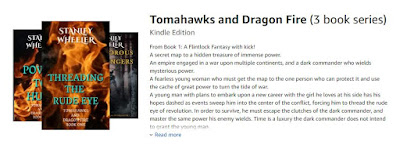
https://www.amazon.com/Tomahawks-Dragon-Fire-3-Book/dp/B08BLQDYJB/ref=sr_1_3?dchild=1&keywords=stanley+wheeler&qid=1593394246&sr=8-3

Sunday, June 21, 2020


All three books in the first trilogy are available for only $0.99 cents each for a limited time.

This is America -- with dragons, and magic, and monsters!


Here are links to each:

Threading the Rude Eye -- Available as an ebook and in paperback.

Power to Hurt -- Available as an ebook and in paperback.

Clamorous Harbingers--Available as an ebook - and coming soon in paperback.


Sunday, June 14, 2020


For Flag Day, allow me to quote myself from Dec. 28, 2017:

"For a few minutes, the audience and players, home and away, are united in reverence and respect for the sacrifices of those who brought forth a new nation conceived in liberty and dedicated to the proposition that all men are created equal, for the brave whose sacrifices have hallowed the cause; we add our devotion to the proposition, with knowledge of past imperfections, but with a desire to preserve this more perfect union." 

When we honor the flag, we honor the nation, its founders, and those who have sacrificed their blood and treasure to protect it. While some prefer to focus upon shortcomings and injustice, both real and imagined, I suggest a recollection and return to the principles of the protection of life, liberty, and property upon which this republic was founded. Theodore Roosevelt said that a successful republic must combine intensity of conviction with broad tolerance for a difference of conviction. He argued, "Bitter internecine hatreds, based on such differences, are signs, not of earnestness of belief, but of that fanaticism which, whether religious or anti-religious, democratic or anti-democratic, is itself a manifestation of the gloomy bigotry which has been the chief factor in the downfall of so many, many nations."

Roosevelt went on to explain that protesters who cannot show love for their own nation because they claim to be citizens of the world, are usually undesirable citizens where ever they may be found. He submitted that anyone who can view his own nation with the same tepid indifference with which he views all other nations is not worthy of trust. That was 110 years go, and it still holds true today. 

***
Fun Facts:
When General Gage sent his combination of light infantry and grenadiers (the elite of his army) after Hancock and Adams in Lexington, and the store of arms and powder at Concord, Dr. Joseph Warren (a fictionalized version of whom appears in Threading the Rude Eye) sent off Paul Revere and William Dawes to alert the countryside. Revere crossed the river to Charleston. Dawes traveled up the Boston Neck peninsula and the two met in Lexington. They persuaded Hancock and Adams to leave, before heading for Concord with a third rider, Samuel Prescott who was returning to his home. A British patrol captured Revere, seizing his horse's bridle, and putting they guns to his chest, but Prescott broke free and rode on. Dawes was thrown from his horse; he returned to Lexington on foot. Prescott alone reached Concord to alert the town. Local riders from Lexington and Concord roused the nearby areas.

Gage's troops were delayed by hours because the navy had not provided enough boats to transport them across the Charles River. An advance guard of 238 British soldiers  arrived at dawn in Lexington. Captain John Parker, a 46 year-old farmer and about 60 militiamen--dairy farmers and craftsmen--met them in the village green. 53 year old Major John Pitcairn (a fictionalized version of whom also appears in Threading the Rude Eye) saw the militia as a ragged collection of troublemakers. Pitcairn ordered the militia to lay down their arms. Parker commanded his men to step aside. 

Someone fired. At this time, no one knows who fired the "shot that was heard around the world." Immediately, anxious men on both sides fired. Most of the militiamen broke and ran. Several were shot down. Some of those were bayoneted where they lay. Eight were killed and nine wounded within one minute. One British soldier was wounded. The British searched the town for Hancock and Adams. Not finding either man, the soldiers started for Concord at about 9:oo o'clock. 

***

Clamorous Harbingers is on the final proof with ten chapters left. It is possible that it will go live by the end of the week -- but no promises. In the meantime, get started on Threading the Rude Eye, and Power to Hurt. Look into the column at the left for the links to the books. My feedback this week from a reader of Threading the Rude Eye: "This book is great!...Riveting!"